
Ear of the
Heart
Reflections, guidance, and gentle stories for listening deeply — to yourself, your loved ones, and the world around you.


When Christianity Met Reiki - Faith, Energy, and the Practice of Discernment
Christians themselves don’t agree about Reiki. Nor does belonging to a particular denomination necessarily tell us what an individual believes. A traditional Catholic might receive Reiki without experiencing a conflict with their faith, while someone with a liberal or progressive spirituality may have serious reservations about it. Two people sitting beside one another in the same church may reach very different conclusions.
Perhaps, then, a more useful question than Is Reiki Christian? is this: Can we encounter a spiritual practice that developed outside our own religious tradition while remaining grounded in—and discerning through—our own spiritual lives?

Using Storybooks to Help Children After Pet Loss
Books can't do the grieving for a child, and there isn't one perfect story that will make the loss understandable or take away the pain. What a story can do is create a shared space where a child and adult can encounter death, feelings, memories, and questions together. Sometimes it is easier to begin by talking about what happened to an animal in a story before talking about the animal whose absence is still so painfully present in your own home.

How to Advocate for Yourself in English Without Sounding Pushy
Self-advocacy does not require choosing between being polite and being clear. In fact, some of the strongest professional communication does both.
Being polite does not mean giving up your right to be understood.

How Ritual Helps Us Honor Death and Life Together
When we hear the word death, we usually think about the end of a physical life. But death, in a broader sense, is woven throughout living. Loss brings its own small death, the ending of something that mattered, even when life itself continues…
Human beings have long used ritual to help us encounter these moments. We tend to associate rituals with religion or major ceremonies, but rituals serve a much broader human purpose. They help us recognize something significant has happened and gives us a way to move through the space between what was and what will be.

Grief as a Spiritual Practice: Learning to Hold What Hurts
For a long time, popular conversations about grief tended to suggest that healing meant gradually moving away from grief. Even though contemporary grief work offers a much more complex picture, many of us still carry an expectation that we should eventually reach a place where the loss no longer affects us quite so much.
What if healing asks something different of us?
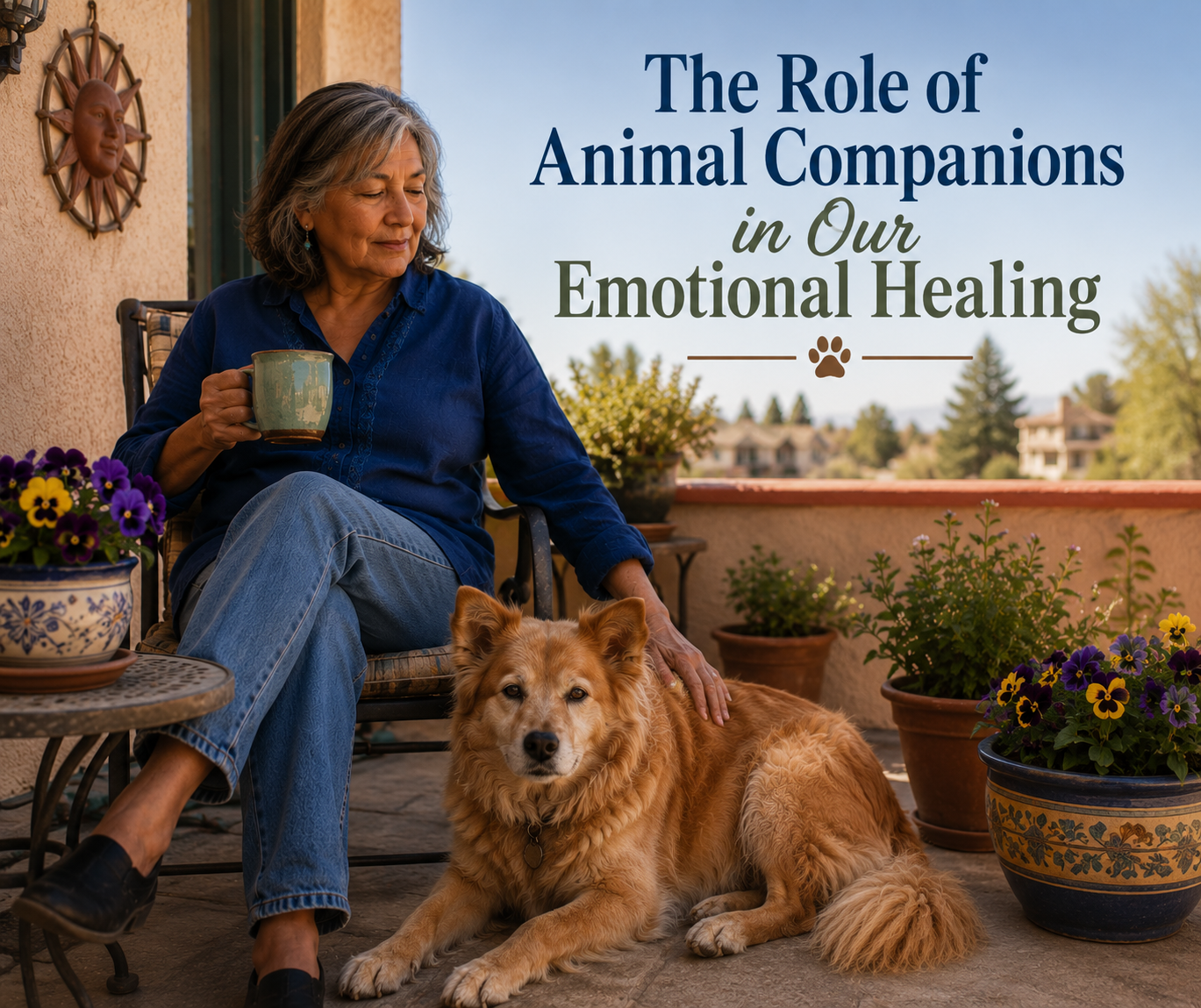
The Role of Animal Companions in Our Emotional Healing
Research into the human-animal bond is helping us understand why presence—and the relationship surrounding it—may matter. The research is more complicated than the familiar claim that “pets are good for our mental health.” Not every person benefits from living with an animal, and having a companion animal doesn't automatically protect someone from depression, anxiety, loneliness, or grief.
Perhaps the more interesting question isn't simply Are pets good for us? It is: What happens within some human-animal relationships that can help support emotional healing?

Finding Your Rule of Life Through Simplicity and Flow
A Rule of Life offers one way to pay attention to that feeling. Despite the word rule, it isn't necessarily a list of requirements or a program for becoming more disciplined. At its best, it can provide a gentle structure for noticing what sustains us, what matters most, and what helps us live with greater intention.
It asks a deceptively simple question: How do I want to live?

Beyond Words: Understanding Intercultural Communication and Connection
For people who use English with tourists, expatriates, international residents, or colleagues, this distinction matters. Learning English gives us a shared language. Intercultural communication helps us create shared understanding.

The Gentle Art of Letting Go: Preparing Emotionally and Spiritually
Letting go is a complicated phrase. It can sound as though there is something we are supposed to accomplish: a final emotional task in which we gracefully accept death, release the person we love, and arrive at peace.
Real dying, and real grieving, are rarely so tidy.

Creating Sacred Space at Home: Simple Ways to Invite Peace
A sacred space can offer that kind of pause. It doesn't have to be a separate room, beautifully decorated, or filled with objects traditionally associated with spirituality. It doesn't even have to be permanent. Sacred space can be as simple as a chair beside a window where you sit quietly each morning, a corner where you light a candle when you need time to reflect, or a few meaningful objects you take from a box and arrange when you want to create a place for prayer, meditation, Reiki, grief, or rest.

Remembering Our Pets Through Legacy Keepsakes
There is no single right way to remember an animal we have loved. What matters isn't what a keepsake looks like or what it costs. What matters is the relationship it helps us remember.

English for Helpers: Compassionate Communication in Healthcare and Hospitality
For professionals working in healthcare, hospitality, caregiving, social services, veterinary care, and other helping environments, English is more than a way to exchange information. It can also communicate reassurance, respect, patience, and presence. Sometimes a very small change in language can make a surprisingly large difference.

Medical Aid in Dying & Human Euthanasia: Global Perspectives on Choice and Dignity
Few conversations about the end of life ask us to sit with as many difficult questions as medical aid in dying and euthanasia.
What does it mean to die with dignity? Who should decide when suffering has become unbearable?

Soul Fatigue: When Compassion Feels Heavy
Soul fatigue isn't a clinical diagnosis, and it doesn't necessarily mean something is wrong. Sometimes it's simply what happens when we've spent too long giving from the deepest parts of ourselves without having enough opportunities to receive, restore, or simply be.
It can happen to caregivers. Helping professionals. Parents. Teachers. People accompanying someone through illness or dying. People who have experienced one loss after another. People deeply affected by what's happening in their communities or in the wider world.

Navigating Guilt After Pet Loss: Finding Grace in Your Grieving Heart
One of the quietest heartbreaks after losing a beloved pet isn't always the grief itself. It's the questions.
The difficult truth is that guilt is rarely a sign that you failed your pet. More often, it is evidence of how deeply you loved them.

Walking the Labyrinth: A Journey Inward and Outward
There are seasons in life when the path ahead feels uncertain… In those moments, many of us instinctively search for answers. But sometimes, what we need most isn’t another answer. Sometimes we simply need a path.
One of the oldest contemplative practices in the world offers exactly that: The labyrinth.

How to Practice English When You're Too Tired to Study
Some days, learning English feels exciting. Other days?
You've worked a long shift.
Taken care of your family.
Finished your classes.
Handled a dozen responsibilities.
By the end of the day, the idea of opening a grammar book or studying vocabulary can feel impossible.

Supporting a Loved One Who Is Afraid of Dying
When someone you love is afraid of dying, it can be difficult to know what to do. You want to comfort them, reassure them, or find the perfect words to ease their anxiety. Yet many people discover that there are no magic words. What often helps most is something much simpler: your presence.

Listening Beneath the Noise: How to Hear the Wisdom of the Body
Many of us become disconnected from one of the quietest — and wisest — sources of information we have: Our own body.
Often, we don’t notice this disconnection until stress, burnout, grief, anxiety, illness, or exhaustion finally force us to slow down and pay attention. But the body has usually been speaking long before that moment arrives.

Recognizing Compassion Fatigue in Pet Care: How to Refill Your Cup
Compassion fatigue is sometimes described as the emotional, mental, and physical exhaustion that can happen when we spend long periods caring for others who are suffering or dependent on us….
And perhaps the hardest part? Many caring people do not recognize it in themselves until they are already overwhelmed.