
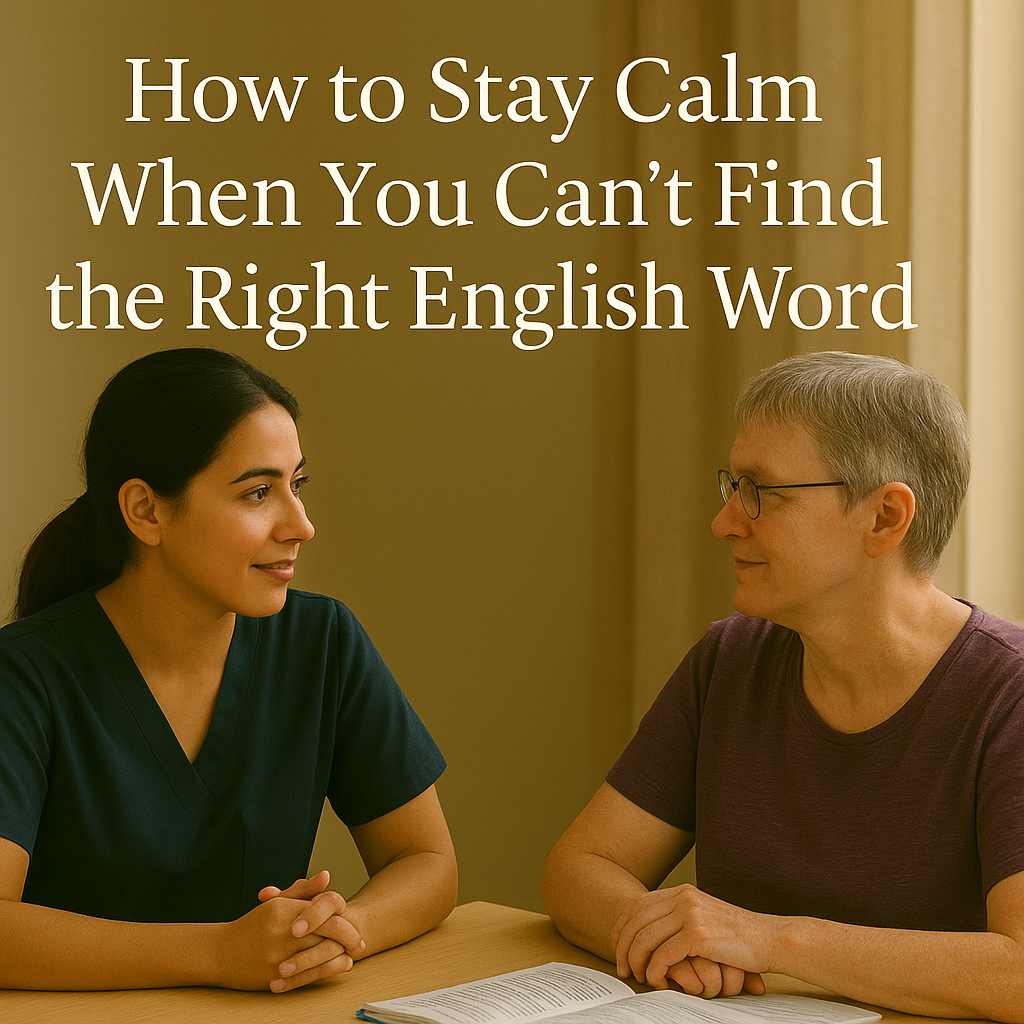
If you work with English-speaking expats in healthcare, caregiving, veterinary services, or hospitality, you’ve probably had this moment: You’re mid-conversation and everything’s going well then, suddenly, your mind goes blank. The right English word is right there, but it won’t come.
Your heart races. You start worrying that you’ll sound unprofessional or that your client will lose confidence in you.
Take a deep breath. This happens to everyone (even native English speakers!). Forgetting a word doesn’t mean you don’t know English. It just means your brain is processing under pressure.
Learning how to stay calm in those moments is a skill, and with a few strategies, you can recover quickly and keep the conversation flowing with confidence.
🌿 Remember: You Know More Than You Think
When you’re speaking another language, your brain is doing something incredible. It’s listening, thinking, translating, and managing emotions all at once. It’s normal for it to pause.
Instead of focusing on what’s missing, remind yourself of what’s working:
You’re communicating complex ideas in another language.
You’re caring for others, solving problems, and connecting across cultures.
Confidence doesn’t come from perfect grammar, it comes from trusting your ability to stay present, even when the words stumble.
💬 Use a “Bridge Phrase” to Keep the Conversation Going
When you can’t find the word, the worst thing you can do is freeze. Instead, use a short phrase to keep the rhythm while your mind catches up.
Try one of these:
“What’s the word…?”
“Let me say it another way…”
“I’m thinking of the word for…”
These phrases buy you time and show that you’re engaged in finding the right way to express yourself, something your clients will appreciate.
Example (Medical Setting):
“I’m thinking of the word for when a patient’s wound closes naturally… ah, healing— the healing process.”
Example (Hospitality Setting):
“Let me say it another way. The room is ready for cleaning now.”
🩺 Describe, Don’t Apologize
Many learners say, “Sorry, my English isn’t good.” Try not to do that, it draws attention to what you think you’re missing instead of what you’re communicating well.
If you can’t find a word, describe what you mean:
“It’s like the medicine that helps you sleep.” (sedative)
“The small towel we give to guests.” (washcloth)
“The tool the vet uses to listen to the pet’s heart.” (stethoscope)
Your listener will likely fill in the missing word for you, and you’ll have practiced staying confident while solving the communication challenge together.
🐾 Turn the Moment into Connection
For many expats, English is their first language, and they may not speak yours. By staying calm and handling language gaps gracefully, you’re modeling cross-cultural communication.
Try this gentle shift. Instead of seeing the pause as a mistake, see it as a shared human moment. It’s a chance to smile, laugh, and build rapport.
“Ah, I lost the English word! That happens to me in every language.”
Small comments like this show humility and warmth, and remind everyone that communication is about connection, not perfection.
🌏 Practice Calm Recovery Techniques
You can train your body and mind to stay steady when you forget a word. Here are a few calming tools that work well for professionals in busy settings:
Breathe out slowly before speaking again, it lowers tension.
Smile, it helps your listener relax, which helps you relax too.
Keep eye contact, it communicates confidence, even if you’re searching for words.
With practice, these reactions become automatic. You’ll still forget words sometimes—everyone does!—but your calm presence will leave a lasting impression.
🕯️ Final Thought: Communication Is More Than Words
Words are tools, but connection is the goal. The people you care for, whether they’re patients, guests, or pet owners, remember how you made them feel, not how perfectly you spoke.
When you stay calm, kind, and confident, you’re already communicating something universal: respect, professionalism, and compassion.
You don’t need perfect English to do your job beautifully. You only need presence, heart, and the courage to keep trying.
👉 At Life and Death Services ~ Language & Learning Support, I help professionals working in caregiving, healthcare, veterinary, and hospitality fields build confidence using English in real-life situations. Together, we focus on practical communication, speaking clearly, listening deeply, and staying grounded, even when the right word takes its time to arrive.