Modern life is loud.
Notifications.
News.
Schedules.
Responsibilities.
Background noise.
Endless scrolling.
Constant pressure to keep moving, producing, responding, and performing.
Over time, many of us become disconnected from one of the quietest — and wisest — sources of information we have: Our own body.
Often, we don’t notice this disconnection until stress, burnout, grief, anxiety, illness, or exhaustion finally force us to slow down and pay attention. But the body has usually been speaking long before that moment arrives.
🌿 The Body as a Form of Wisdom
Listening to the body doesn’t mean treating every sensation as an emergency, or assuming every feeling contains a mystical message. It simply means recognizing that physical and emotional sensations are forms of information.
Our nervous systems are constantly processing both internal and external experiences, often long before the conscious mind fully catches up.
Sometimes the body notices what the mind has not yet put into words.
A sense of heaviness before burnout.
A tightness in the stomach around a difficult situation.
A feeling of expansion and ease around something that feels deeply aligned.
A wave of exhaustion after prolonged caregiving or emotional stress.
A subtle sense that something feels “off,” even when everything looks fine on the surface.
These aren’t failures. They’re signals.
Trauma researchers and somatic practitioners often speak about how the body carries stress, fear, grief, and experience long after the conscious mind moves on. This idea became widely known through the work of Bessel van der Kolk in The Body Keeps the Score, which explores how trauma and overwhelming experiences can continue affecting both the nervous system and the body long after an event has ended.
We may intellectually tell ourselves that we’re “fine,” while the body continues holding tension, hypervigilance, exhaustion, bracing, or emotional overwhelm beneath the surface.
This can show up in many quiet ways:
Tight shoulders or clenched jaws
Gut upset during periods of anxiety or conflict
Shallow breathing
Chronic fatigue
Difficulty relaxing
Restlessness or emotional numbness
Feeling emotionally flooded or constantly on edge
A sense of heaviness, contraction, or resistance
Difficulty feeling fully present or grounded
The body remembers what the mind sometimes tries to rush past. And while the body is not infallible, learning to listen gently and consistently can help us better understand our limits, needs, emotions, and inner sense of alignment.
🧠 Why So Many of Us Lose Touch with the Body
Many people were never taught to trust bodily awareness. Instead, we’re often encouraged to override discomfort, ignore exhaustion, push through stress, and stay productive no matter what our nervous systems are experiencing.
We live in a culture that rewards disconnection.
People praise themselves for surviving on little sleep.
Working through burnout.
Ignoring emotional pain.
Remaining constantly busy.
Over time, this can create a life lived mostly “from the neck up”—heavily cognitive, but disconnected from physical and emotional awareness. And when the body does speak loudly through anxiety, panic, illness, exhaustion, or emotional overwhelm, many people feel frustrated with it rather than curious about what it might be trying to communicate.
✨ Common Ways the Body Speaks
The body’s language is often subtle. It may show up as:
Tightness or bracing in the shoulders, chest, or jaw
A sinking feeling in the stomach
Tingling or energetic shifts
Fatigue that feels deeper than ordinary tiredness
Restlessness or agitation
A sense of openness and calm around certain people or decisions
Resistance that keeps returning despite logical reasoning
Emotional tears that appear “out of nowhere”
Feeling drained after certain interactions
Feeling grounded and peaceful in certain spaces
Sometimes the body communicates through intuition, what many people call a “gut feeling.”
Not every sensation should be interpreted literally, of course. Anxiety, trauma histories, stress, and medical conditions can all influence how we experience bodily signals.
But over time, patterns emerge. And learning those patterns can become a form of self-understanding.
🕯️ Three Practices for Deep Listening
The Somatic “Yes or No?”
This simple practice can help you notice whether your body feels aligned or resistant around a decision.
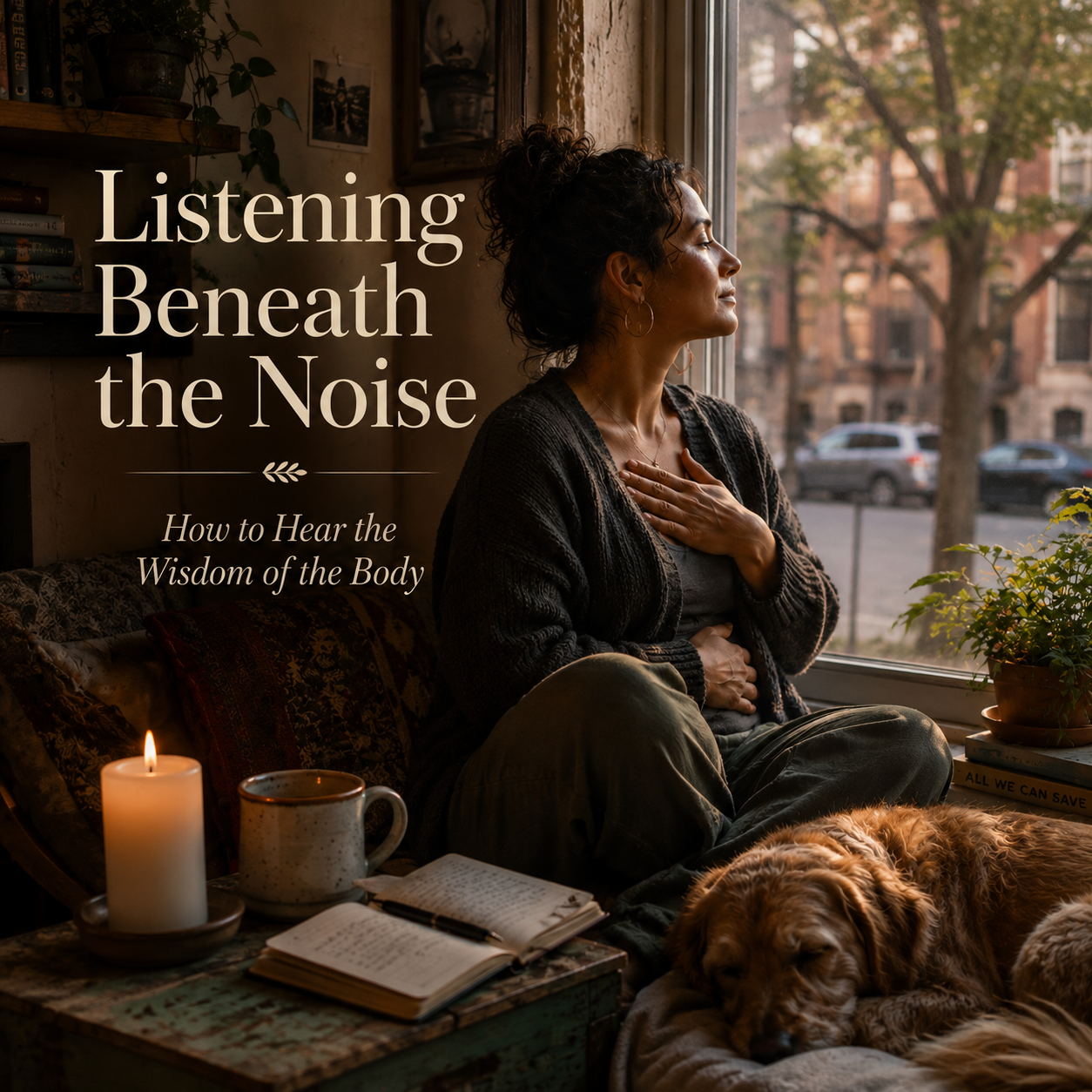
Place one hand over your heart and the other over your abdomen.
Take a slow, deep breath. Let your diaphragm expand. Exhale slowly.
Then ask yourself a simple, binary question:
Do I want to attend this event?
Do I have the capacity for this commitment right now?
Does this choice feel supportive or draining?
Then notice your body’s response. Do you feel more expansive, grounded, open, or light? Or do you notice contraction, heaviness, tightness, or fatigue?
This practice isn’t about finding a perfect answer. It’s about becoming more aware of your body’s patterns and responses.
A 10-Second Check-In
You don’t need an hour-long meditation practice to reconnect with yourself. Sometimes ten seconds is enough.
A few times each day, pause briefly.
Drop your shoulders.
Unclench your jaw.
Notice your breathing.
Wiggle your toes.
Then ask yourself gently: How does my body feel right now? What do I need in this moment?
You may notice hunger, tension, sadness, fatigue, overstimulation, or the need for rest. Or perhaps you notice ease.
The goal isn’t to “fix” every feeling immediately. The goal is simply to notice. Of course if you notice that you’re hungry, a snack might be a reasonable response.
Intentional Stillness (aka Listening Beneath the Noise)
Many people move through life with constant input.
Television.
Music.
Podcasts.
News.
Social media.
Notifications.
Conversation.
Background noise.
It’s hard to find silence in the modern world. Silence can feel unfamiliar, even uncomfortable. But intentional stillness creates space to notice what belongs to us and what belongs to the noise around us.
Even a few minutes without screens, media, reading, or distraction can help the nervous system settle enough for deeper awareness to emerge.
What emotions rise when everything becomes quiet?
What thoughts keep returning?
What sensations have been ignored?
Stillness isn’t about emptying the mind perfectly. It’s about creating enough space to hear yourself again.
For those who find guided support helpful, apps such as Insight Timer offer free somatic meditations, nervous system practices, breathwork exercises, and grounding meditations that can help you begin reconnecting with bodily awareness gently and gradually.
Another resource I appreciate is The Somatic Therapy Workbook, by Lisa Powers, which offers accessible exercises and reflections for people interested in reconnecting with bodily awareness, emotional regulation, and nervous system support in gentle, practical ways.
💙 The Body Is Not the Enemy
Many people live in conflict with their bodies.
We criticize them.
We ignore them.
We push them past exhaustion.
We treat them as obstacles rather than companions.
But often, the body is trying to protect us.
To slow us down.
To alert us.
To help us recognize what is unsustainable.
To guide us back toward balance.
Listening to the body doesn’t mean becoming ruled by fear or sensation. It means becoming more compassionate and attentive toward ourselves.
It also means recognizing that wisdom isn’t only intellectual. Sometimes it is physical. Emotional. Energetic. Quiet.
And often, beneath all the noise of modern life, the body has been trying to speak to us all along.
🕯️ Creating Space to Listen
Learning to listen to the body isn’t about achieving perfect calm or constant self-awareness. It’s about slowly rebuilding trust with yourself.
Sometimes that process happens in solitude. And sometimes it happens in supportive relationships where we feel safe enough to slow down, reflect, and notice what is happening beneath the surface.
At Life and Death Services, I offer gentle, inclusive support for people navigating grief, caregiving, burnout, spiritual questioning, life transitions, and emotional overwhelm. Through spiritual direction, Reiki, and compassionate listening, I help create space for grounding, reflection, nervous system support, and deeper connection with your own inner wisdom.