5 English Phrases That Help You Sound More Professional and Polite
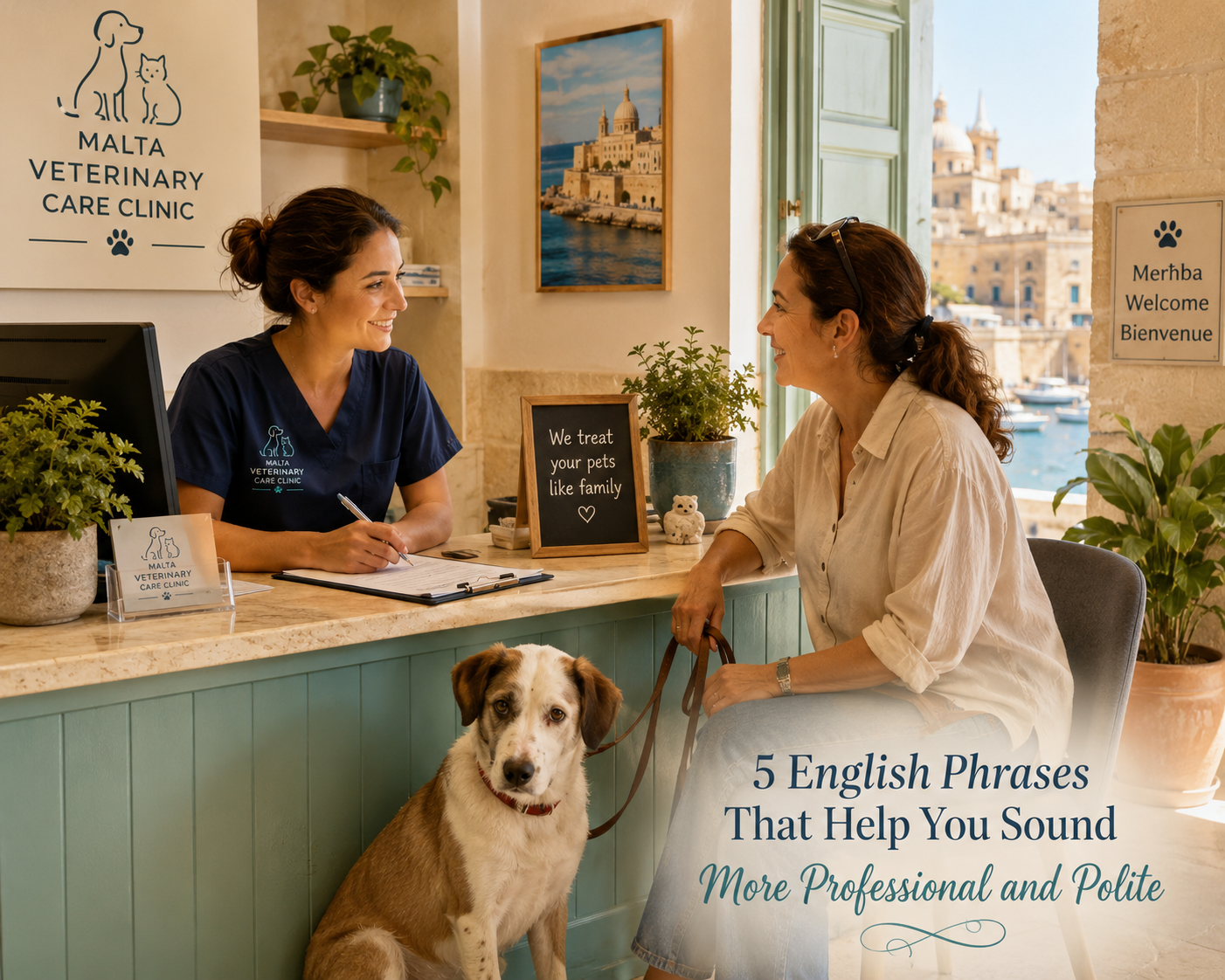
Many English learners focus heavily on grammar and vocabulary, but professional communication is also about tone.
In workplaces across healthcare, hospitality, education, veterinary care, customer service, and social services, how something is said often matters just as much as the information itself.
Small language shifts can help you sound:
more professional
more collaborative
more confident
and more respectful
These phrases don’t make your communication weaker. Instead, they add warmth, flexibility, and emotional intelligence to professional conversations.
It’s also important to remember that these phrases are especially common in American English workplace culture, where people often soften requests, disagreement, or feedback in order to maintain a collaborative and respectful tone.
In some cultures, more direct communication is considered efficient or respectful. In many American workplaces, however, softer phrasing is often interpreted as more professional, approachable, and emotionally aware. This is also true for many Americans living abroad, especially in professional, healthcare, hospitality, and customer service settings where relationship-building and tone matter greatly.
Here are five simple language shifts that can make a surprisingly big difference.
🌿 1. Softening Requests
Instead of saying:
❌ “Send me the report.”
Try:
✅ “Could you take a quick look at this when you have a moment?”
✅ “When you get a chance, could you send over the report?”
These phrases soften direct requests and show respect for the other person’s time and workload. In American workplace culture, this often sounds more collaborative and professional rather than demanding.
This kind of language is especially useful in:
emails
teamwork
healthcare settings
customer service
office communication
🌿 2. Asking for Help Politely
Instead of saying:
❌ “Can you help me?”
Try:
✅ “I was hoping you might be able to help me with this.”
✅ “I wanted to check whether you had time to go over this with me.”
These phrases sound thoughtful and considerate rather than abrupt. They are common in professional conversations because they give the other person space to respond comfortably.
They also help build stronger working relationships by creating a more respectful tone.
🌿 3. Asking for Clarification Without Sounding Confrontational
Instead of saying:
❌ “That doesn’t make sense.”
Try:
✅ “I want to make sure I’m understanding correctly.”
✅ “I may be misunderstanding part of this. Could you explain it another way?”
This type of phrasing is extremely valuable in professional environments, especially when working with:
patients or clients
coworkers
supervisors
teachers
customers
These phrases reduce defensiveness and help conversations remain calm and collaborative, even when confusion or disagreement exists.
Professional communication is not just about being correct. It is also about helping people feel respected while solving problems together.
🌿 4. Asking Questions More Politely
Instead of saying:
❌ “Do you know where the files are?”
Try:
✅ “Would you happen to know where the files are?”
✅ “Do you by any chance know where the files are kept?”
Small additions like “would you happen to” or “by any chance” soften direct questions and make interactions feel warmer and more polite.
These phrases are especially common in:
reception work
hospitality
healthcare offices
customer service environments
everyday workplace interactions
They help create a friendlier and more approachable tone without sounding overly formal.
🌿 5. Delivering Difficult Information Gently
Instead of saying:
❌ “We can’t do that.”
Try:
✅ “Unfortunately, I don’t think we’ll be able to do that.”
✅ “I’m afraid that timeline may not be possible, but we may have another option.”
Professional communication often involves difficult conversations:
declining requests
discussing delays
correcting misunderstandings
setting boundaries
explaining problems
These phrases soften disappointment while still communicating clearly and honestly. They help preserve trust and reduce tension during stressful situations.
In many helping professions, this balance between honesty and compassion is especially important.
🌿 Professional Does Not Mean Cold
One common misunderstanding among English learners is the belief that professional communication must sound distant, formal, or emotionally flat.
In reality, many strong communicators combine professionalism with warmth.
Tone matters!
People are more likely to feel comfortable, cooperative, and respected when communication sounds calm, thoughtful, and considerate. This is especially true in healthcare, social work, veterinary settings, hospitality, and other helping professions where trust and emotional safety matter deeply.
Being professional does not mean sounding robotic. It means communicating clearly while remaining respectful and human.
✨ Small Changes Can Make a Big Difference
You don’t need perfect English to communicate professionally.
Very often, small shifts in phrasing create a noticeable difference in how others experience working with you. These changes help conversations feel:
calmer
more collaborative
more respectful
and more confident
Professional communication is not about sounding overly formal. It’s about helping people feel informed, respected, and comfortable while still communicating clearly and effectively.
And like any communication skill, it becomes easier with practice.
🕯️ Language & Learning Support Through Life & Death Services
At Life & Death Services ~ Language & Learning Support, communication is approached as more than grammar and vocabulary. Language is also about connection, trust, emotional awareness, and relationship-building.
Support is available for:
healthcare professionals
veterinary professionals
hospitality workers
social work students
ESL learners
helping professionals working with English-speaking clients, patients, and families
Together, we focus on building communication skills that sound both professional and genuinely human.