
The Power of Storytelling in End-of-Life Work
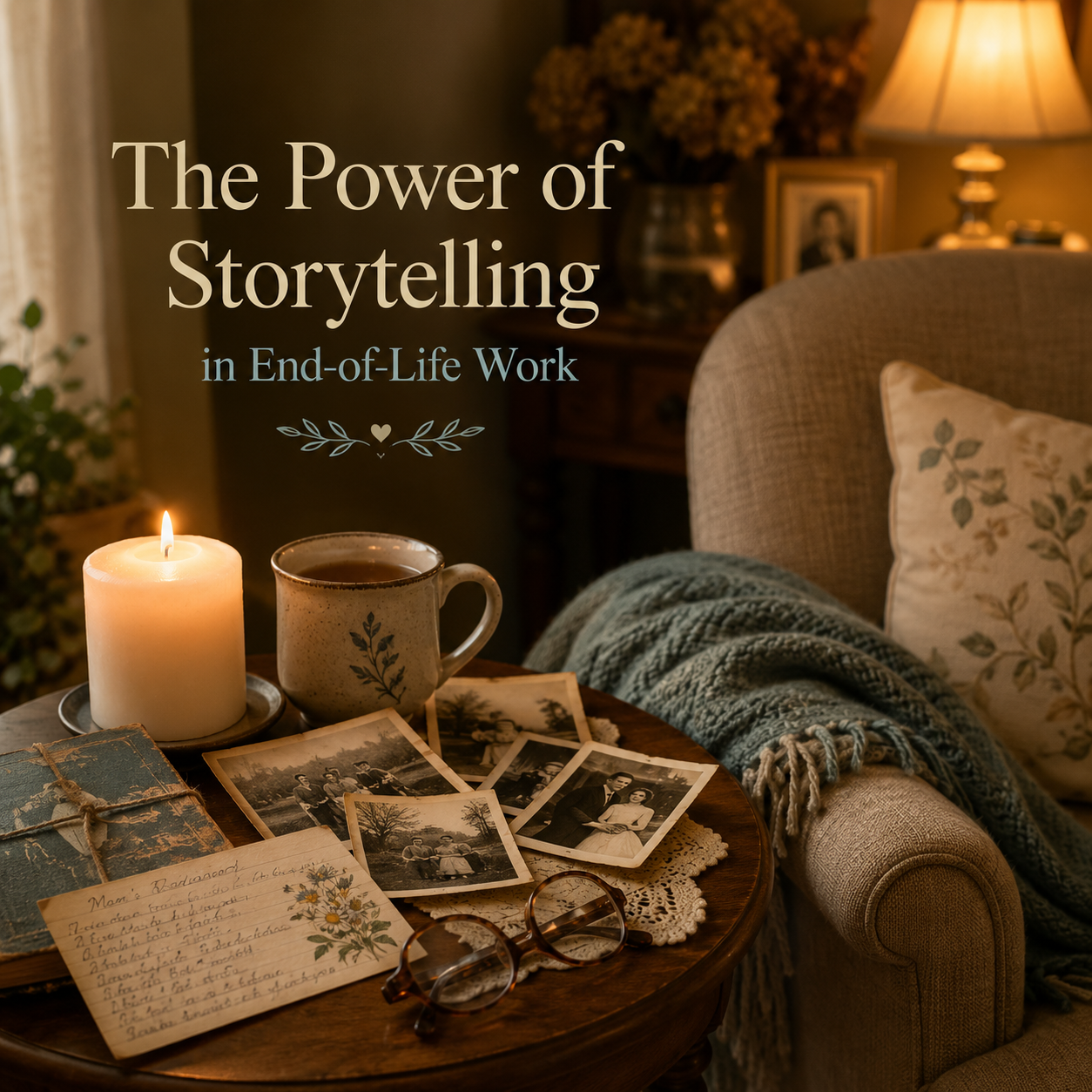
As life draws closer to its end, many people begin telling stories.
Not always intentionally.
Not always in order.
Sometimes the same memory returns repeatedly.
A childhood moment surfaces unexpectedly. A favorite family story is repeated at the dinner table. A person who has been quiet for days suddenly recalls the name of a beloved dog, a first dance, or the smell of bread baking in a childhood kitchen.
These stories are rarely random. Often, they are part of how people make meaning, preserve identity, process emotion, and remain connected to themselves and the people they love.
In end-of-life work, storytelling becomes more than conversation. It becomes a way of honoring a life.
🌿 Stories Help Us Remain Ourselves
Serious illness and the dying process can change many things. Bodies weaken. Roles shift. Independence may lessen. Medical language and routines can begin to overshadow the person at the center of it all.
Stories gently push back against this. They remind everyone involved that a person is more than a diagnosis, more than a treatment plan, and more than the condition affecting their body.
A story says:
This is who I’ve been.
These are the people I’ve loved.
These are the moments that shaped me.
This is the life I lived.
Even simple memories can carry deep significance. A favorite meal. A job someone held for thirty years. A family vacation retold countless times. The ordinary details of a life are often what make someone feel fully known.
In this way, storytelling helps preserve dignity and personhood, especially during times when so much else feels uncertain or out of one’s control.
🕯️ Storytelling as Emotional and Spiritual Processing
Stories also help people process the emotional and spiritual realities of nearing the end of life.
As memories surface, people may revisit:
joy and regret
grief and gratitude
relationships and losses
moments of courage, humor, tenderness, or sorrow
Sometimes these reflections are spoken directly. Other times they emerge quietly through repetition, fragments of memory, or seemingly ordinary stories that carry emotional weight beneath the surface.
Not every story is meant to provide closure or resolution. Sometimes storytelling is simply a way of staying connected to what has mattered.
There can be healing in speaking aloud what has been carried silently for years.
🌿 Being Heard Is Part of Compassionate Care
One of the most meaningful things we can offer another person at the end of life is our attention.
Not interruption.
Not correction.
Not the pressure to “stay positive.”
Just listening. Deep listening reminds people they’re still fully human, even as the body changes.
In end-of-life work, storytelling isn’t about performance or polished memory. It’s about witnessing. It’s about allowing someone to speak their life into the room and trusting that it deserves space to be heard.
Sometimes the greatest gift is not advice, but attention.
🪶 Ordinary Stories Matter Too
When people think about legacy, they often imagine major accomplishments or dramatic life moments. But many of the stories families hold closest are surprisingly ordinary.
The way someone laughed.
The songs they always sang in the car.
The meals they cooked without measuring.
The dog who followed them everywhere.
The tiny rituals that shaped daily life.
These stories matter because they carry texture, personality, and presence. They remind us that a meaningful life isn’t only built through milestones, but through repeated acts of love, care, humor, and connection.
At the end of life, even small stories can become sacred.
🌿 Storytelling and Grief
Storytelling continues long after a death has occurred.
Families gather and say:
“Remember when…”
“She always used to…”
“He would have loved this…”
Grief often sounds like storytelling. In speaking the stories of those we love, we continue our relationship with them. We keep their presence moving through our lives in new ways. Stories become one of the ways memory remains active, shared, and alive.
Sometimes grief softens not because we stop remembering, but because remembering becomes less painful and more companionable over time.
🕯️ Presence Matters More Than Perfect Memory
Near the end of life, memories may become fragmented or nonlinear. A person may repeat the same story multiple times, blend timelines together, or lose certain details altogether.
Perfection is not the point. The emotional truth beneath the story often matters far more than factual precision.
What matters is the feeling of being heard, respected, and accompanied.
Storytelling in end-of-life work is not about creating a perfectly organized life narrative. It is about creating space for reflection, connection, and presence in whatever form they arrive.
🌿 The Sacredness of Witnessing
To listen deeply to another person’s story is to say: Your life mattered enough for me to hear it.
That kind of witnessing can be profoundly healing for both the storyteller and the listener. It reminds us that even as life changes, weakens, or nears its end, meaning still lives in relationship, memory, and shared humanity.
At the end of life, stories become more than memories.
They become ways of saying:
This is who I was.
This is what mattered.
Please know me.
🕯️ Support Through Life & Death Services
At Life & Death Services, storytelling and life review are approached as deeply human and relational practices. Whether through spiritual direction, end-of-life companionship, vigil support, or grief support, space is created for people to reflect on their lives, share memories, process meaning, and feel heard without judgment or pressure.
Sometimes healing begins not through answers or solutions, but through being witnessed with compassion and care.
No story must be perfect to matter.