
Walking the Labyrinth: A Journey Inward and Outward
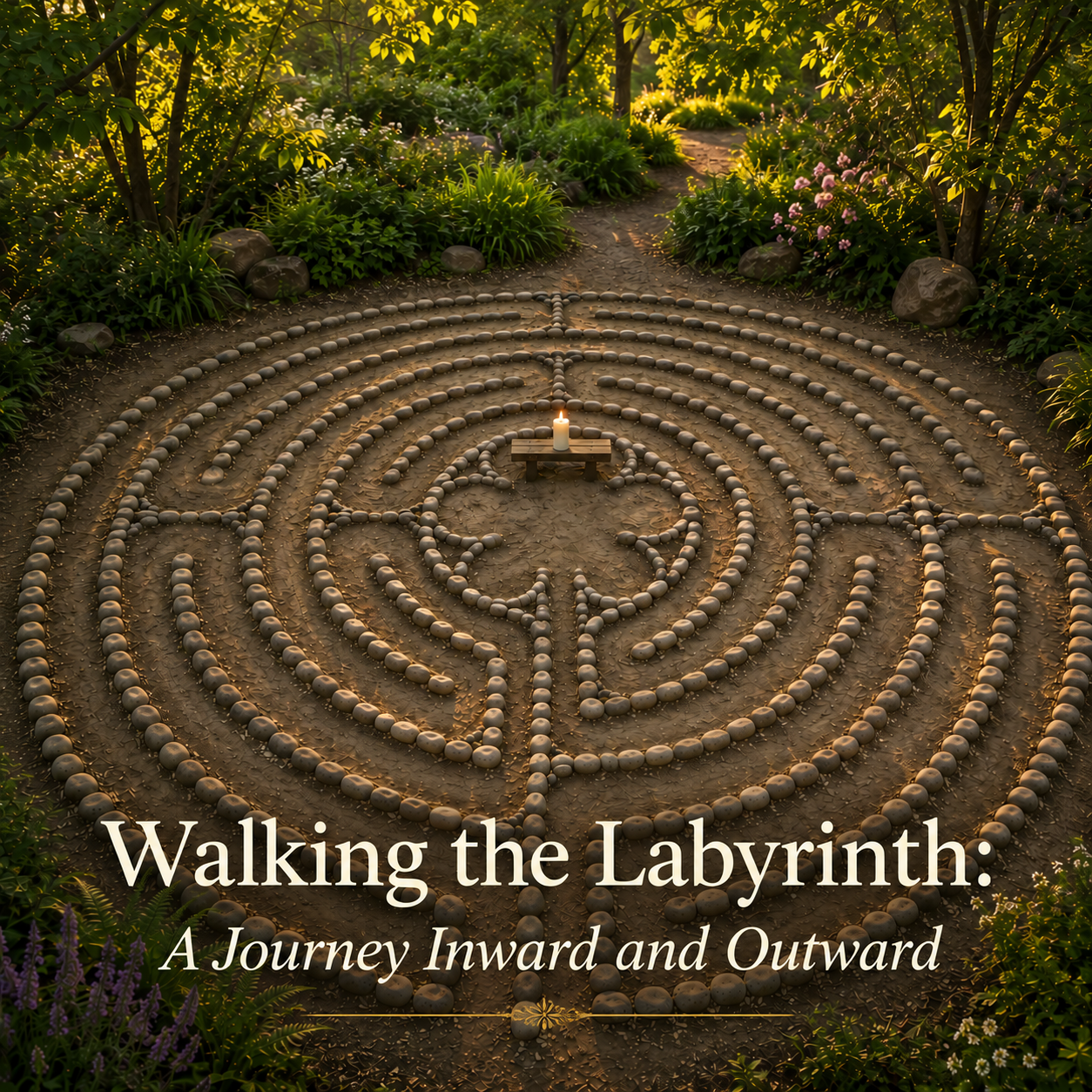
There are seasons in life when the path ahead feels uncertain. We might be grieving a loss, caring for a loved one, facing a difficult decision, questioning our purpose, or simply feeling as though life has become too hurried for us to hear our own hearts. In those moments, many of us instinctively search for answers.
But sometimes, what we need most isn’t another answer. Sometimes we simply need a path.
One of the oldest contemplative practices in the world offers exactly that: The labyrinth.
Unlike a maze, which is designed to confuse and challenge, a labyrinth has only one path. There are no dead ends, no wrong turns, and no tricks hidden around the next corner.
There is only one way in. One center. And one way back out.
For centuries, people from many different traditions have walked labyrinths as a form of prayer, meditation, reflection, healing, and spiritual practice. Today, labyrinths can be found in churches, hospitals, retreat centers, parks, schools, and community spaces around the world, offering anyone a place to slow down and simply walk.
🌿 What Is a Labyrinth?
At first glance, a labyrinth can look confusing. The path twists and turns, doubling back on itself so often that it can appear as though you're moving away from the center rather than toward it.
But every step belongs to the same path. You cannot take a wrong turn. You cannot become lost. That alone can be a surprisingly powerful lesson. Much of life feels uncertain.
We second-guess ourselves.
We wonder if we've made the wrong decision.
We worry that we've somehow fallen behind or wandered off course.
The labyrinth quietly reminds us that progress isn't always linear. Sometimes what feels like moving away is actually bringing us closer.
🌀 An Ancient Practice Across Traditions
Labyrinths have appeared in many cultures throughout history. One of the most well-known examples is the labyrinth embedded in the floor of Chartres Cathedral in Chartres Cathedral in the Centre-Val de Loire region, where medieval pilgrims walked the winding path as an act of prayer and pilgrimage.
Today, labyrinths are found in Christian churches, retreat centers, hospitals, universities, public gardens, and community parks. People from many different faith traditions—and those with no formal religious tradition at all—walk labyrinths as a contemplative or meditative practice.
Some come seeking healing. Some bring grief. Some carry questions. Others simply long for a few moments of quiet in a noisy world.
The labyrinth welcomes them all.
🌱 The Three Movements of the Labyrinth
While every walk is unique, many people experience the labyrinth in three gentle movements: the journey inward, the center, and the journey outward.
These aren't rigid stages or rules. They're simply invitations.
🚶 Walking Inward
The journey toward the center is a time for noticing. As you walk, you might gently ask yourself:
· What am I carrying?
· What feels heavy?
· What questions am I holding?
· What have I been avoiding?
· What needs my attention today?
You don't need to solve anything. Simply notice.
The rhythm of walking often quiets the analytical mind enough for deeper thoughts and emotions to surface naturally. Some people pray. Some breathe quietly. Some walk in silence. Others simply pay attention to the feeling of one foot stepping in front of the other.
I've seen people dance, skip, and even crawl through a labyrinth, each engaging the journey in a way that felt authentic to them.
One of the most meaningful walks I've experienced was with my eyes closed, my hand resting on my guide's shoulder as she gently led me along the path. Surrendering the need to see where I was going invited me to practice something deeper than navigation, it invited me to trust. That walk became a powerful reminder that there are times in life when we cannot see the path ahead, but we can still move forward one faithful step at a time.
The practice of labyrinth walking isn't about thinking harder. It's about becoming more present.
🕯️ Resting in the Center
Eventually, you arrive. The center isn't a finish line. It's a place to pause, rest.
Many people stand quietly for several moments. Others sit if seating is available. Some pray. Some meditate. Some simply breathe.
The center isn't necessarily where answers appear. Often, it's where striving softens. Where we stop trying to fix everything. Where we allow ourselves simply to be.
Before beginning the walk outward, many people find it meaningful to reflect on two gentle questions:
What am I ready to leave here?
Perhaps it's fear.
Guilt.
Resentment.
Perfectionism.
A burden you've carried for far too long.
Then ask: What do I want to carry back into my ordinary life?
Perhaps it's peace.
Hope.
Courage.
Self-compassion.
A renewed sense of purpose.
Or simply the reminder that you are not walking alone.
The center becomes a place not only of reflection, but of intention.
🌅 Walking Outward
The journey outward isn't about returning to life unchanged. It's about bringing the experience with you.
As you make your way back toward the entrance, notice your body. Has anything shifted? Do your questions feel different? Has your breathing slowed?
Has something become clearer, or perhaps become a question worth living with for a while longer?
When you reach the entrance where your walk began, resist the temptation to simply step away. Pause. Turn. Look back toward the labyrinth. Take a moment to acknowledge whatever this journey has offered you.
Perhaps it was peace.
Perhaps clarity.
Perhaps renewed questions.
Perhaps simply the gift of slowing down.
There is no "right" outcome. The practice itself is the gift.
🕯️ The Labyrinth and Life
Our culture often teaches us to focus on destinations. We ask ourselves:
"When will I get there?"
"When will this be over?"
"When will I have the answer?"
The labyrinth asks a different question: How am I walking this part of the journey?
Its wisdom isn't found in arriving quickly. It's found in paying attention to each step.
Life, after all, rarely moves in straight lines. Healing isn't linear. Grief doesn't follow a schedule. Discernment seldom takes the shortest route.
Sometimes we revisit old questions. Sometimes we feel as though we've gone backward. Sometimes the path seems to carry us farther away from where we hoped to be.
Yet, just like the labyrinth, we might still be moving exactly where we need to go. The turns, pauses, and unexpected stretches of the journey are not interruptions. They are part of the journey itself.
The labyrinth reminds us that transformation often happens while we're walking, not simply when we arrive. The journey, not the destination, is ley.
🌍 Finding a Labyrinth Near You
If you've never walked a labyrinth before, you may be surprised to discover how many quietly exist in churches, retreat centers, hospitals, parks, schools, and community spaces.
One of my favorite resources is the Labyrinth Locator, a free worldwide directory where you can search for public labyrinths by location.
Jody and I have discovered many beautiful labyrinths through this resource over the years. We've made a point of walking them in the different places we've lived, and each one has offered something a little different. Some were tucked into church gardens, others were nestled among trees or built into quiet retreat centers. Yet despite their differences, they all offered the same invitation:
Slow down.
Pay attention.
Trust the journey one step at a time.
If there isn't a labyrinth near you, don't let that discourage you. Finger labyrinths—small printed or wooden labyrinths traced with a finger—offer many of the same contemplative benefits.
You can also create a simple temporary labyrinth using stones, shells, sticks, or other natural materials in your yard or a nearby park.
Some people even choose to carry the spirit of the labyrinth into an ordinary walk. The destination becomes less important than the intention. Each step becomes an opportunity to notice your breathing, your surroundings, your thoughts, and the quiet wisdom that often emerges when we stop rushing.
🌿 Who Might Benefit from Walking a Labyrinth?
While anyone can walk a labyrinth, many people find it especially meaningful during seasons of transition or uncertainty.
You might consider walking a labyrinth if you are:
· Grieving the death of someone you love
· Caring for a family member or aging pet
· Facing a major life decision
· Beginning retirement or another significant transition
· Living with illness or chronic pain
· Feeling burned out or emotionally overwhelmed
· Longing for greater spiritual connection
· Seeking clarity without needing immediate answers
You don't need to arrive with a specific goal. Sometimes simply showing up is enough.
The labyrinth has a way of meeting us exactly where we are.
✨ A Final Reflection
Walking a labyrinth will not solve every problem. It won't erase grief. It won't eliminate uncertainty. And it probably won't provide a dramatic revelation waiting at the center.
But it might offer something equally valuable. An hour of slowing down. A chance to breathe more deeply. Permission to stop striving for a little while. Space to listen. And perhaps a gentle reminder that life isn't simply about reaching the destination. It's about how we walk the path before us.
The labyrinth teaches us that every step matters. That turning back doesn't always mean going backward. That pauses have value. That the center isn't a place we conquer, but a place we encounter.
And that we never truly walk alone.
🕯️ Creating Space to Walk
In many ways, spiritual direction is a bit like walking a labyrinth. It isn't about someone handing you the answers or telling you which way to go. Instead, it creates a safe, compassionate space to slow down, pay attention, and notice where the Spirit—or your deepest wisdom—is already at work in your life.
At Life & Death Services, I offer spiritual direction for people navigating grief, caregiving, life transitions, discernment, burnout, questions of meaning, and seasons of change. Together, we create space for deep listening, gentle reflection, and discovering the next faithful step, not by rushing toward certainty, but by learning to trust the journey itself.
Sometimes the most meaningful transformation doesn't happen because we finally found all the answers. Sometimes it happens because we learned how to walk with greater presence, compassion, and hope.