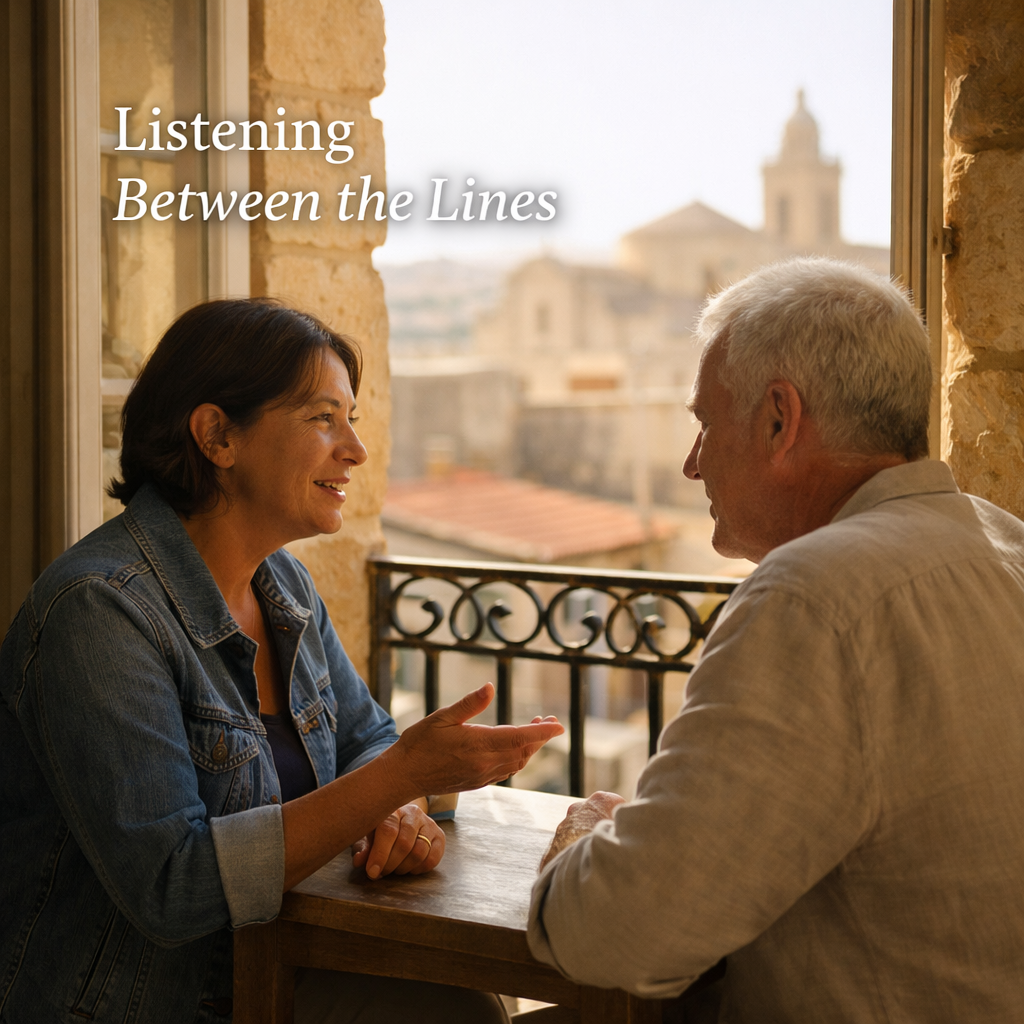
Listening Between the Lines: Understanding Tone and Intention in English
Have you ever understood every word someone said and still felt confused?
Maybe the sentence made sense, but something about it didn’t quite sit right. Or maybe you realized later that the meaning wasn’t what you first thought it was.
That’s because in English, communication is not just about vocabulary or grammar. It’s also about tone and intention, the feeling behind the words and the reason they’re being said.
And that’s where things can get tricky.
🗣️ What Is Tone?
Tone is the emotional quality or attitude behind what someone says.
It’s carried through things like pitch, pace, volume, and word choice, but also through subtle shifts in emphasis that can completely change meaning.
Take a simple phrase:
“I guess that works.”
Said gently, it might mean agreement.
Said with a pause and a sigh, it might mean reluctance.
Said quickly and flatly, it might signal dismissal.
The words stay the same. The meaning does not.
Tone is what gives language its texture. Without it, communication would feel flat and mechanical. With it, even a short sentence can carry warmth, irritation, humor, or care.
🎯 What Is Intention?
If tone is how something sounds, intention is why it’s being said.
Intention reflects the speaker’s purpose. Are they trying to help? To correct? To connect? To challenge? To soften a difficult message?
For example:
“Do you have a minute?”
This could be a simple request for time.
It could also signal that something important—or even serious—is coming next.
The words alone don’t tell the whole story. The intention fills in that missing layer.
🔄 Tone and Intention: Working Together
Tone and intention are always interacting, whether we realize it or not. When they align, communication feels clear. When they don’t, things can feel confusing or even uncomfortable.
Imagine someone says:
“Thanks for your feedback.”
With a warm tone, it feels appreciative.
With a clipped or flat tone, it might feel forced—or even annoyed.
Same sentence. Different experience.
As listeners, we are constantly interpreting both tone and intention at the same time, often without even thinking about it.
🎭 Why This Matters in Everyday English
English, especially in the United States, relies heavily on tone.
Two people can say the same sentence and mean completely different things. And for non-native speakers, this can feel like trying to read between invisible lines.
This matters in everyday situations:
• In the workplace, where tone can affect professionalism and trust
• In healthcare or social services, where tone can influence comfort and safety
• In friendships and relationships, where tone shapes connection
Misreading tone can sometimes lead to misunderstandings. But more often, it simply creates a moment of uncertainty. Did they mean that the way it sounded?
That question alone tells you how important tone really is.
🗨️ Spoken Tone vs. Written Tone
Tone shows up differently depending on how we communicate.
🗣️ Spoken Tone
In conversation, we have many clues:
· Intonation (voice rising or falling)
· Facial expressions
· Body language
· Timing and pauses
All these help us understand meaning more easily, even when words are unclear.
✍️ Written Tone
In writing, those cues disappear.
Instead, tone is carried through:
· Word choice
· Punctuation
· Sentence structure
· Formatting
For example:
“I’ll look into it.”
“I’ll look into it!”
“I’ll look into it…”
Each one feels slightly different.
Emails, texts, and workplace messages often rely on tone in ways that are easy to misinterpret, especially when you don’t know the person well.
🎧 Learning to Hear What Isn’t Said
Understanding tone and intention is less about memorizing rules and more about developing awareness.
Here are a few ways to begin:
👂 Listen to the “music” of speech
Notice where the voice rises or falls. Pay attention to which words are emphasized. Often, meaning lives there.
❓ Ask yourself: “Why are they saying this?”
Are they offering support? Giving feedback? Expressing concern? The intention can guide your interpretation.
🧭 Consider the context
A comment from a close friend may carry a very different tone than the same words from a supervisor.
🌱 Notice patterns over time
Over time, you’ll begin to recognize how different people communicate—and how tone shows up in their speech.
💡 A Few Everyday Examples
Let’s look at how tone and intention can shift meaning:
“You’re early.”
· Said with a smile → welcoming
· Said with surprise → unexpected
· Said with tension → possibly inconvenient
“Take your time.”
· Gentle tone → supportive
· Sharp tone → impatient
“We should talk.”
· Calm tone → planning a conversation
· Serious tone → signaling concern or conflict
None of these are about right or wrong interpretations. They are about possibility and learning to stay curious.
🌿 When You’re Not Sure
Even native speakers get this wrong sometimes.
If something feels unclear, it’s okay to pause and check:
· “Just to be sure I understand…”
· “Do you mean…?”
· “Can you tell me a little more?”
These small moments of clarification are not mistakes. They are part of good communication.
🕯️ Listening with Care
At its heart, understanding tone and intention is about more than language. It’s about listening, really listening, not just to words, but to what sits beneath them.
In my work through Life and Death Services, I often sit with people in moments where words don’t fully capture what they are feeling. Tone, presence, and intention carry just as much meaning as anything spoken out loud.
Whether you are learning English, working in a helping profession, or simply trying to connect more deeply with others, this kind of listening matters. Because sometimes, what we most need to hear is not said directly.
And sometimes, what we most need to offer is our attention.