
How Ritual Helps Us Honor Death and Life Together
When we hear the word death, we usually think about the end of a physical life. But death, in a broader sense, is woven throughout living. Loss brings its own small death, the ending of something that mattered, even when life itself continues. Relationships end. Children grow up and leave home. We retire from work that shaped our identity for decades. We move away from houses, neighborhoods, and communities that hold important chapters of our lives. A pregnancy ends in loss. A friendship changes beyond repair. Our bodies change, and something we once could do is no longer possible. A caregiving role ends. Sometimes a future we imagined for ourselves simply doesn’t happen.
These experiences aren’t interchangeable, and the grief surrounding a miscarriage isn’t the same as the grief of retirement or moving to a new city. Yet they share something fundamental: something that once existed no longer exists in the same way. There has been an ending, and endings—even necessary, welcomed, or chosen ones—can bring grief alongside whatever else we may be feeling.
Human beings have long used ritual to help us encounter these moments. We tend to associate rituals with religion or major ceremonies, but rituals serve a much broader human purpose. They help us recognize something significant has happened and gives us a way to move through the space between what was and what will be.
🕯️ What Do We Mean by Ritual?
We sometimes use the word ritual casually to describe anything we do regularly: our morning coffee ritual, our bedtime ritual, our Sunday afternoon walk. Repetition can certainly be part of ritual, but from the perspective of fields such as anthropology, sociology, and religious studies, ritual is more than just routine.
Ritual involves symbolic action(s) through which people express, create, or acknowledge meaning. A ritual can connect us with a community or cultural tradition. It can affirm an identity, preserve a memory, express a spiritual belief, or mark a significant transition. Some rituals have been practiced for generations and come with established words, symbols, roles, and expectations. Weddings, funerals, coming-of-age ceremonies, graduations, religious observances, and citizenship ceremonies all tell participants, and the larger community, that something important is happening.
Other rituals are private and personal. They may involve only one person, last only a few minutes, and have no established script at all. What gives the action significance isn’t necessarily its complexity or age, but the meaning(s) attached to it.
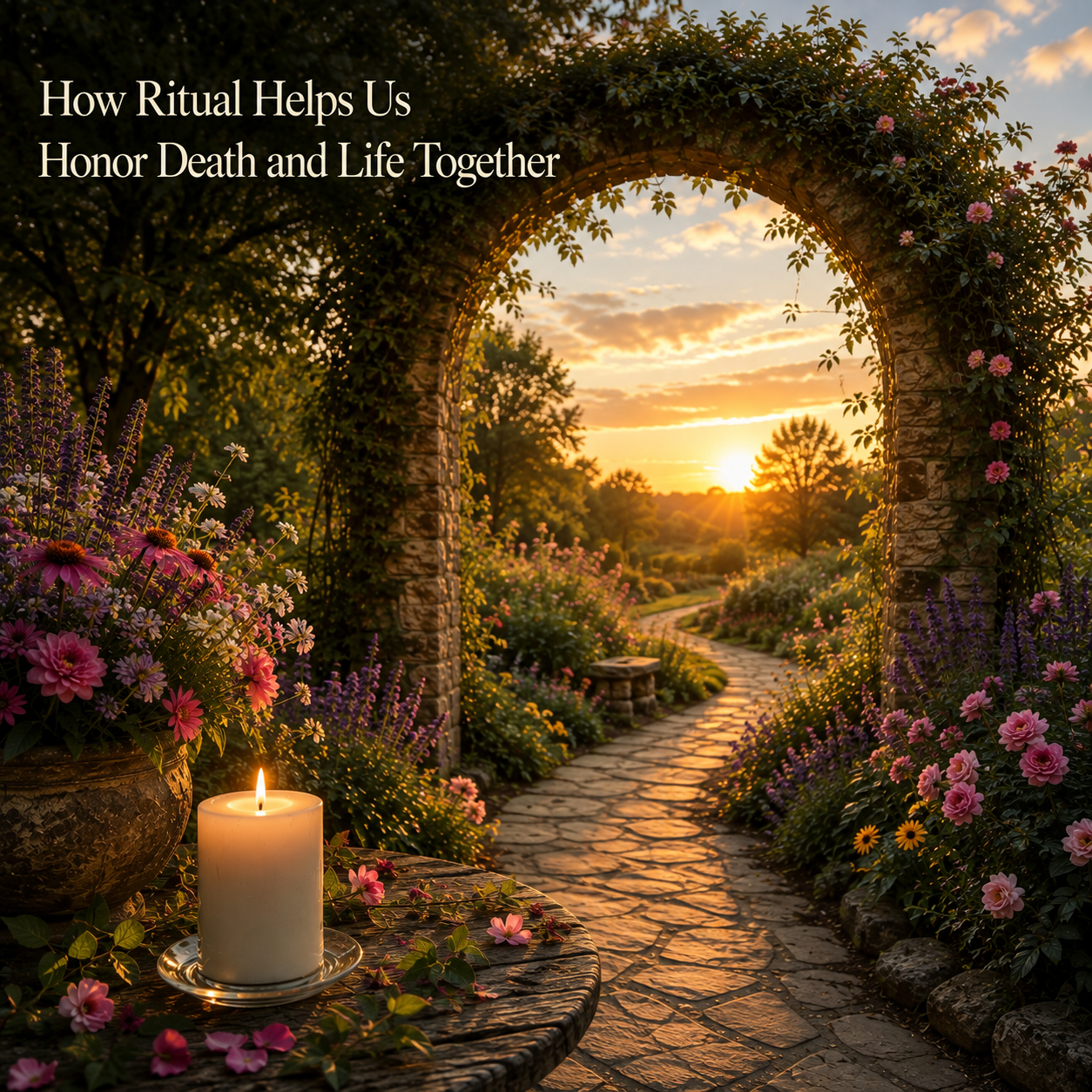
Lighting a candle is an ordinary act. Lighting a candle every year on the date of a loss and sitting quietly with the memories attached to that person, relationship, or experience turns an ordinary action into something different. The candle becomes symbolic. It creates a moment set apart from everyday life in which we can say, in whatever words make sense to us: I remember. This mattered. I’m grieving. I’m grateful. I’m letting go.
So, when it comes to ritual and symbolic actions, there’s also an important distinction between the mundane and the sacred. I might light a candle simply because I enjoy the warmth or light it brings to a room. The action itself is ordinary. But I can take that same action and intentionally set it apart, giving it meaning beyond its practical purpose. In that moment, I’m not simply lighting a candle; I’m creating sacred space around a memory, a loss, a hope, or a transition. The object or action doesn’t have to be inherently sacred. Our intention and the meaning we give it can make the moment sacred. This is part of what ritual allows us to do: take something ordinary and use it to acknowledge that, for this moment, we’re attending to something that matters.
🌿 Ritual Gives Emotion Somewhere to Go
One reason ritual can be particularly valuable during life transitions is that our emotional responses to endings are rarely simple. We might feel several things at once, including emotions that seem to contradict each other.
Retirement may bring relief and excitement alongside fear, grief, and uncertainty about identity or purpose. Divorce can contain anger and sadness while also bringing liberation or hope. Parents whose children leave home may be enormously proud of the independent adults they have raised while grieving the loss of everyday family life. A long-awaited move can be exactly the right decision and still hurt. When caregiving ends, a person may experience profound grief alongside exhaustion, relief, guilt, love, and the disorienting realization that a role around which daily life revolved is suddenly gone.
We often feel pressure to sort those emotions into categories: Was this a good thing or a bad thing? Am I happy or sad? If I chose this, am I still allowed to grieve it? If I feel relieved, does that mean I didn't love enough?
Ritual doesn't require us to answer those questions. Instead, it can create a container for emotion, a space in which seemingly contradictory feelings are allowed to coexist. Rather than demanding we explain or resolve everything we feel, ritual gives those feelings expression through action. We might speak words aloud, light something, bury something, plant something, prepare food, make music, walk a familiar path, gather with people who understand the significance of the moment, or simply sit quietly and acknowledge what has changed.
The action itself doesn’t eliminate the emotion; it gives the emotion somewhere to be held.
🌅 Liminality: Living at the Threshold
There’s another concept from the study of ritual that helps explain why these practices can matter so much during periods of change: liminality.
The word is related to the Latin limen, meaning threshold. Like the moment captured in a sunrise (or sunset) 🌅—when night is ending but day has not yet fully arrived—liminality describes the space between what was and what comes next. Early scholars of rites of passage observed that significant transitions often involve a period in which a person has left one status, role, or identity but hasn’t yet fully entered another. Later scholars expanded the idea, but that image of the threshold remains a useful way to understand many ordinary human transitions.
Imagine standing in a doorway. Behind you is the room you’ve left. Ahead is the room you’re entering. For a moment, however, you’re not entirely in either one.
Many of life's transitions feel exactly like that. A newly retired person is no longer going to work each morning but might not yet know what retirement will mean for identity, relationships, routine, or purpose. Someone leaving a marriage is no longer living within the old relationship but may not yet recognize the new life taking shape beyond it. Parents whose last child has left home remain parents, of course, but the everyday practice of parenting has fundamentally changed. After a move, the old place is no longer home, while the new place may not feel like home yet.
These in-between periods can be uncomfortable partly because our familiar markers have disappeared. We know what was, but we don't yet know exactly what will be. Ritual can help us inhabit that uncertainty rather than rushing past it. It gives us something meaningful to do while we’re standing at the threshold. Ritual can also become part of the mechanism that helps us cross that threshold, marking our movement from one way of being into another. Through symbolic action, we acknowledge not only what we’re leaving behind, but that we’re beginning to step into a changed identity, role, relationship, or way of life.
🌿 Some Losses Have Rituals. Others Don't.
Our communities already provide rituals for many major transitions. When someone dies, most cultures and religious traditions offer some framework for what happens next: funerals, wakes, memorial services, vigils, burial practices, meals, periods of mourning, anniversaries, prayers, or other forms of remembrance.
We also have rituals for many socially celebrated transitions, including weddings, graduations, births, retirements, anniversaries, and new homes.
But there are other endings that can profoundly alter a person's life while receiving little public acknowledgment. There may be no ceremony for leaving the house where you raised your family. No established ritual marks the end of a friendship that shaped twenty years of your life. A retirement party can celebrate professional accomplishments without making room for the complicated experience of relinquishing an identity inhabited for decades. Divorce paperwork legally ends a marriage, but signing a document doesn’t necessarily acknowledge what was loved, lost, learned, regretted, or survived within that relationship.
Pregnancy loss can be especially painful in this regard. Parents may already have imagined a future, formed an attachment, or begun reorganizing their understanding of themselves and their family while the people around them may have barely known the pregnancy existed. Loss through suicide can also carry complexity. Alongside grief, survivors might be navigating shock, anger, guilt, unanswered questions, or stigma, while people around them can feel uncertain about what to say or even avoid acknowledging the death altogether. In both circumstances, when a loss isn’t fully recognized or openly supported by the surrounding community, there can be fewer communal spaces and practices available to acknowledge what’s happened.
This is one reason the concept of disenfranchised grief can be useful. Some grief isn’t fully recognized, socially supported, or given the same permission to exist as other grief. When there’s no established ritual available, creating one can become a way of bearing witness to our own experience. It allows us to say: There may not be a ceremony for this, but this mattered.
🌱 We Can Create Ritual Where None Exists
Ritual doesn’t have to belong to an organized religion, nor does it need to be elaborate to carry meaning. For people rooted in religious or spiritual traditions, established practices can provide language, symbols, community, and continuity during periods of transition. For others, a ritual can be created specifically for the experience being marked.
Someone leaving a longtime home might walk slowly through each room before closing the door for the last time, remembering what happened there and offering gratitude for the life the house held and nurtured. A newly retired person might gather objects representing different stages of a career and decide intentionally what to keep, what to give away, and what no longer needs to be carried forward. Someone moving through divorce might write a letter acknowledging both what the relationship gave them and what they’re ready to release. A family experiencing pregnancy loss might plant something that blooms each year. A person whose caregiving role has ended might light a candle at the time of day when a familiar caregiving task once occurred, honoring both the person they cared for and the part of themselves that carried that responsibility.
A ritual might include a candle, a letter, a meal, a meaningful object, music, flowers, water, a walk, a fire, a garden, a photograph, or simply words spoken aloud. It can happen alone or in community. It can be solemn or joyful, or—perhaps most truthfully—some combination of the two.
The question is less: What am I supposed to do? And more: What action would help me acknowledge what this transition means?
💛 Honoring Death and Life Together
One of the gifts of ritual is that it doesn’t require us to divide experience neatly into beginnings and endings. In real life, they’re often happening at the same time.
Retirement ends one way of organizing a life while opening the possibility of another. Moving means leaving and arriving. An empty nest contains absence, but it can also represent the successful launching of people we have spent years preparing to make lives of their own. Divorce can mean grieving what a relationship was, what it never became, and what we hoped it would be while also recognizing the possibility of a different future.
Even physical death holds this complexity. Grief exists because a life was lived, relationships were formed, memories accumulated, and love had somewhere to take root. Our rituals around death often look backward and forward simultaneously: remembering the person or living being who died while helping the living begin to understand a world in which that person is no longer physically present.
Ritual makes room for both realities. We can mourn what has ended while remaining open to what is emerging. We can say thank you and goodbye in the same breath. We can honor the many deaths within a human life without treating every ending as a failure or every new beginning as a reason we should no longer grieve what came before.
🌿 Ritual Is Not the Same as Closure
We often hear people talk about seeking “closure” after a loss, as though grief or transition were a door that could eventually be shut behind us. Human experience is usually more complicated than that.
A ritual cannot erase grief or make a difficult transition painless. It cannot guarantee that we’ll understand what happened, resolve every feeling, or suddenly feel ready for whatever comes next. We might, and often do, return to the meaning of an ending many times as our lives continue to change.
Perhaps that is why marking is a more useful idea than closing. Ritual marks a moment in time. It acknowledges that there was a before, there is an after, and we’ve crossed—or are still crossing—the space between them.
A ritual can say: This happened. This mattered. Something has changed. I don’t have to pretend otherwise.
It can also say: I can carry something from what was into whatever comes next.
That is how ritual can help us honor death and life together, not by denying endings, and not by remaining permanently inside them, but by giving ourselves a meaningful way to recognize the thresholds through which a human life continually passes.
🕯️ Creating Meaning Through Life & Death Services
At Life & Death Services, I work with people navigating many kinds of loss thresholds: death and dying, grief, caregiving, spiritual questions, changing identities, and significant life transitions. Through spiritual direction and end-of-life doula support, there can be space to explore the rituals, practices, symbols, and conversations that feel meaningful to you.
Sometimes that means drawing upon an established religious, spiritual, or cultural tradition. Sometimes it means creating a personal ritual for an experience our communities have never taught us how to mark. There’s no single correct way to stand at, or cross, a threshold.
What matters is giving ourselves permission to recognize that endings deserve our attention, too. Honoring what has ended doesn’t keep us from living. Sometimes it’s precisely what helps us carry what mattered forward while making room for the life that comes next.