
There are seasons when life becomes crowded almost without our noticing. One responsibility leads to another. Habits accumulate. Calendars fill. Our phones offer an endless stream of things requiring our attention, and even activities we genuinely value can begin competing with one another for whatever time and energy remain. We might be working, caregiving, maintaining relationships, attending appointments, tending a home, trying to stay healthy, raising children, keeping up with the news, answering messages, and perhaps attempting to squeeze in something that resembles a spiritual practice.
Nothing has necessarily gone terribly wrong. And yet we may begin to sense that the life we're spending so much energy maintaining doesn't quite feel like the life we intended to live.
A Rule of Life offers one way to pay attention to that feeling. Despite the word rule, it isn't necessarily a list of requirements or a program for becoming more disciplined. At its best, it can provide a gentle structure for noticing what sustains us, what matters most, and what helps us live with greater intention.
It asks a deceptively simple question: How do I want to live?
🌿 An Old Idea That Has Continued to Evolve
The language of a Rule of Life has deep roots in Christian monastic tradition. Early monastic communities developed rules to shape their shared spiritual lives, and one of the most enduring is the Rule of St. Benedict, written in the sixth century. Benedict's Rule provided a practical and spiritual framework for communal life, giving rhythm to prayer, work, rest, study, hospitality, relationships, and the ordinary responsibilities of living together. The Rule itself also points to earlier Christian sources and monastic traditions, including the Rule of Basil; Benedict was building within an existing tradition rather than inventing the idea from nothing.
Over time, the idea traveled beyond the monastery. Rules of Life have continued within Christian religious communities, but they have also been adapted for people living ordinary lives outside monastic walls. Some contemporary Christian communities are even intentionally “dispersed”: their members share a Rule and common rhythm while living in their own homes and working in the wider community.
The concept has also been interpreted more broadly in spiritual and secular settings. A contemporary Rule of Life might be explicitly grounded in someone's relationship with God, informed by a different spiritual tradition, or understood simply as an intentional framework for living according to deeply held values.
The details have changed considerably across centuries and contexts, but the underlying question remains surprisingly recognizable: How shall I live?
For our purposes, a Rule of Life doesn't need to reproduce a monastic practice or require any particular religious belief. We can think of it as a way of listening to our lives: noticing what sustains us, what draws us toward our deepest values, where some structure might help us flourish, and where we may need greater freedom.
🌱 A Trellis Rather Than a Fence
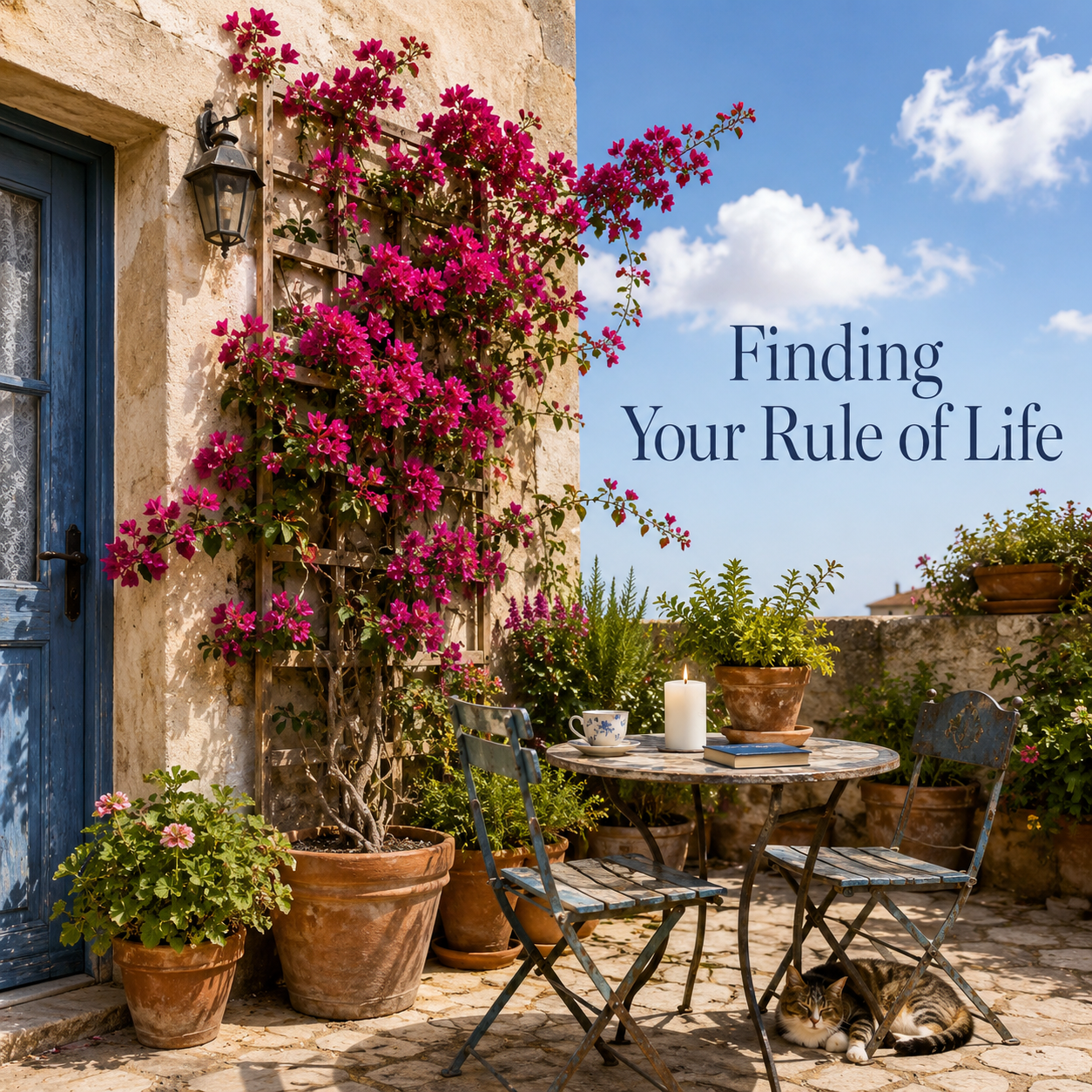
One helpful way to imagine a Rule of Life is as a trellis. A fence tells us where we can not go. A trellis does something different. It provides enough structure for a living thing to grow. That distinction matters because it’s very easy to turn a Rule of Life into another self-improvement project.
Meditate every morning. Exercise five days a week. Journal every night. Read something meaningful for thirty minutes. Call family every Sunday. Volunteer twice a month. Spend less time online. Drink more water. Get eight hours of sleep… Before long, our beautiful Rule of Life has become another list of ways we can disappoint ourselves.
A useful Rule shouldn't make life feel smaller or more punitive. Its purpose is not to control every hour or transform us into the idealized person we think we ought to be. Instead, it can give the things that matter somewhere to grow.
Perhaps you value contemplation but discover that weeks pass without any quiet. You value friendship but repeatedly tell people you care about that you'll get together “soon.” Creativity matters deeply to you, yet everything else receives your energy first. You believe rest is important while treating it as something you must earn after everything else is finished.
The Rule helps us notice the distance between what we say matters and what our lives currently have room to hold. Not so we can criticize ourselves. So we can become curious about the distance.
🍃 Simplicity Is Not the Same as Having Less
Simplicity is often presented visually: uncluttered rooms, nearly empty closets, carefully chosen possessions, white walls, and beautifully organized shelves.
There might be genuine freedom in owning less, but spiritual simplicity is larger than minimalism. Spiritual simplicity asks us to become more discerning about what receives our finite attention.
Some things complicate our lives because they genuinely matter. Loving other people can be complicated. Caring for an aging parent is complicated. Raising children, tending animals, participating in a community, creating meaningful work, and living through illness or grief can all resist simplification.
The goal isn't to remove everything difficult. Instead, we might begin asking which complexities belong to the life we actually want to live, and which ones we continue carrying simply because we have never stopped to reconsider them.
What are we maintaining from habit?
What are we doing because we think we should?
What once served us but no longer does?
What have we said yes to so many times that we've forgotten we could choose differently?
And perhaps most importantly: What would you like to have enough room in your life to notice?
That question takes simplicity out of the closet and puts it back into the soul.
🌊 Paying Attention to Flow
The word flow is often associated with psychologist Mihaly Csikszentmihalyi's work describing states of deep absorption in meaningful activity. That kind of flow can certainly tell us something about what engages and energizes us. But there’s another, more ordinary kind of flow worth noticing when we're considering a Rule of Life: where does life seem to move naturally, and where does it repeatedly catch?
Perhaps you’ve been trying for years to establish an early-morning contemplative practice because you believe spiritually serious people begin their days in silence. Unfortunately, at 6:00 a.m., the only spiritual experience you're having is resentment toward the alarm clock.
At 9:00 at night, however, the house becomes quiet. You make tea. You read. You think. Something inside you settles.
That’s information.
Perhaps you've repeatedly tried to journal and never maintained the practice, yet your thoughts become clear when you're walking. Maybe sitting meditation makes you restless, while gardening leaves you deeply centered. Perhaps you keep trying to create elaborate weekly family gatherings when the conversations that actually sustain those relationships happen during short, spontaneous phone calls.
We can spend enormous amounts of energy trying to force ourselves into practices that look meaningful from the outside while overlooking the places where meaning is already happening.
A Rule of Life can help us stop asking only, What should I be doing? We can also ask: Where is life already flowing?
🪶 Begin With What Is Already Alive
This might be one of the gentlest ways to begin developing a Rule of Life. Before adding anything, notice what’s already working.
What leaves you feeling more grounded?
Where do you experience connection?
When do you feel most fully yourself?
What helps you become more compassionate, curious, creative, or present?
Where do you experience the sacred, however you understand it?
The answers might include formal spiritual practices such as worship, prayer, meditation, Reiki, sacred reading, or time with a spiritual community. They may also include morning coffee on the porch, walking the dog, cooking with someone you love, tending plants, writing, making music, sitting beside water, volunteering, having dinner with friends, or reading before bed.
We don't need to divide our lives too quickly into things that are “spiritual” and things that aren't. Sometimes the practices already sustaining us are so ordinary that we've stopped recognizing their importance.
A Rule of Life gives us an opportunity to notice them again.
🧭 Rhythm Is Different From a Schedule
Once we recognize what matters, we can begin thinking about rhythm. Human lives contain natural movements between activity and rest, solitude and relationship, giving and receiving, work and play, speaking and listening. Problems can arise when one part of the rhythm expands until there is little room for anything else.
A Rule of Life can help us notice that imbalance without requiring us to schedule every dimension of being human.
Perhaps we need some quiet each day, meaningful contact with people we love each week, regular time outdoors, periods when work genuinely ends, opportunities for creativity, participation in community, or practices that connect us with something larger than ourselves.
Those things don’t all need appointments on a calendar. What they need is somewhere to live.
A rhythm is different from a rigid schedule because it can breathe. Some weeks contain more solitude; others are filled with people. There are seasons of intense work and seasons when rest becomes essential. There might be periods when spiritual practice feels rich and others when showing up at all is enough.
The purpose of rhythm isn't perfect balance. It’s remembering that no single part of life is meant to consume the whole.
💙 Notice Where Life Keeps Catching
Flow doesn't mean we should abandon anything that feels difficult. Some of the most meaningful parts of life require persistence, discipline, and uncomfortable growth. But repeated friction deserves attention.
Perhaps you consistently feel depleted after a particular commitment. Maybe something you once loved has become an obligation you dread. Perhaps your schedule technically accommodates everything, yet there’s never enough transition time to arrive anywhere emotionally present.
Sometimes the problem isn't the activity itself. It’s the way we've arranged it.
And sometimes friction reveals a deeper misalignment.
A Rule of Life can create space to ask questions we might otherwise avoid. Does this still belong in my life? Am I doing this because it matters to me or because I’m afraid to disappoint someone? Is this difficult because growth is difficult, or because something in me is asking for change?
We won't always know immediately. Discernment rarely arrives as a flashing sign. But it often begins as noticing.
🌾 Make the Rule Small Enough to Live
Once we begin thinking about what matters, there can be a temptation to design an entire life all at once. We don't have to. A Rule of Life can begin very simply.
Perhaps, for this season, your Rule is: I want to make room each day for quiet, each week for someone I love, and regularly for something that reminds me the world is larger than my obligations.
That's enough to begin.
Another person might focus on rest, community, creativity, the body, spiritual practice, service, or time outdoors. Over time, the Rule may become more detailed. Or it may remain beautifully simple.
The question isn't whether it looks impressive on paper. The question is whether it helps you live. A Rule that exists only in a journal isn't necessarily serving us. A small rhythm we actually inhabit may be far more transformative than an elaborate plan for the person we hope someday to become.
🍂 Your Rule Should Change Because You Do
A Rule of Life isn't a contract we sign with our future selves. Lives change.
We become caregivers. We become parents. Children leave home. Relationships begin and end. Bodies age. Illness arrives. Someone dies. We retire. We move. Work changes. Faith changes. Things that once gave us energy stop doing so, and unexpected interests begin calling us toward something new.
A Rule that supported us beautifully at 35 might make little sense at 65. Even a Rule that worked last year may not fit the life we're living now.
This isn't failure. The trellis exists for the living thing, not the other way around.
There can be seasons when our Rule becomes very small. During grief, illness, caregiving, or exhaustion, practices that once felt nourishing may become impossible. Perhaps the Rule for that season is simply to rest when we can, accept help, remain connected to one or two people, and find one small way to return to ourselves.
When life opens again, the Rule can open with it.
🕯️ A Rule of Life as a Practice of Listening
Creating a Rule of Life doesn't require sitting down one afternoon and deciding how the rest of your life should work. It may begin with listening. For a week or a month, notice when you feel spacious and when you feel constricted. Notice what energizes you and what consistently drains you. Pay attention to the moments when you feel present rather than hurried, connected rather than scattered.
Notice what you miss. Notice what you keep saying you want to return to. Notice what you might be ready to release.
These observations will begin to reveal a pattern. Over time, we can recognize the practices, relationships, commitments, boundaries, and rhythms that help us live closer to what we value.
For some people, that discernment is explicitly spiritual and grounded in prayer or relationship with the Divine. For others, it may be an exploration of values, meaning, purpose, and the kind of person they hope to be in relationship with themselves, other people, and the world.
Either way, the Rule grows from attention rather than prescription.
🌿 Simplicity, Flow, and the Life We Are Already Living
At Life & Death Services, spiritual direction can provide space for this kind of discernment. Rather than offering a prescribed Rule of Life, spiritual direction can help us notice what is moving within our lives, where we experience connection or resistance, what may be asking for greater attention, and what we may be ready to release.
A Rule of Life isn’t a blueprint for becoming someone better. It’s a way of paying attention to the life already moving through us—what gives it energy, what constricts it, what deserves tending, and what may finally be ready to be released.
Simplicity clears some of the clutter. Rhythm gives what matters somewhere to live. Flow helps us notice where life is opening and where it repeatedly catches. And, over time, a Rule of Life can become less a set of practices we follow than a quiet way of remembering who we want to be.