
Creating Sacred Space at Home: Simple Ways to Invite Peace
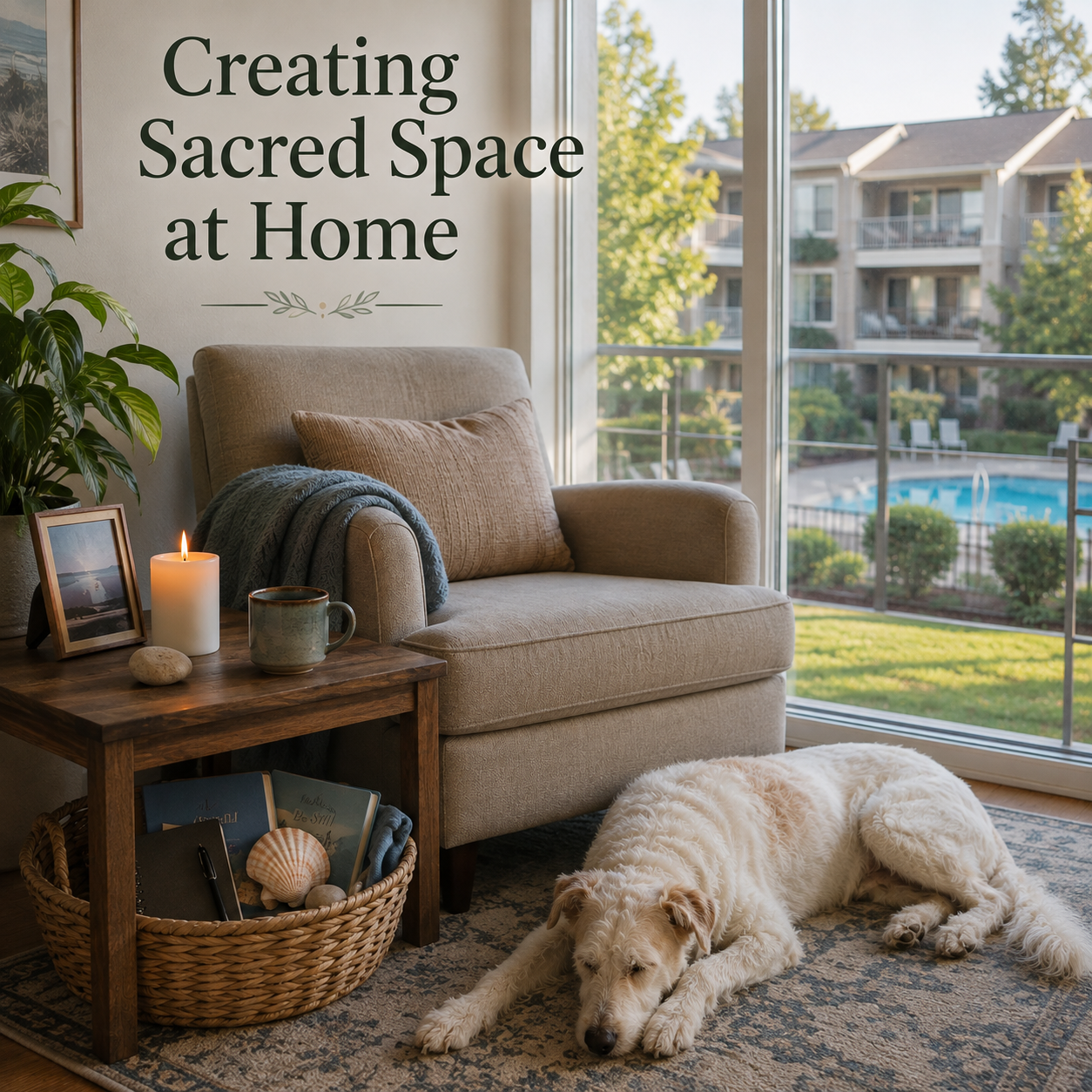
There are places in our homes where life simply happens. We cook dinner, answer emails, fold laundry, feed animals, watch television, sort the mail, and leave things sitting on the counter that we fully intend to put away later.
And then, sometimes, there are places where we intentionally allow ourselves to be still.
A sacred space can offer that kind of pause. It doesn't have to be a separate room, beautifully decorated, or filled with objects traditionally associated with spirituality. It doesn't even have to be permanent. Sacred space can be as simple as a chair beside a window where you sit quietly each morning, a corner where you light a candle when you need time to reflect, or a few meaningful objects you take from a box and arrange when you want to create a place for prayer, meditation, Reiki, grief, or rest.
What makes the space sacred isn't necessarily what’s in it. It’s the intention with which we enter it.
🕯️ What Do We Mean by Sacred?
The word sacred can sound explicitly religious, and for many people it is. A sacred space might include a cross, icon, prayer beads, sacred text, or objects connected to a particular faith tradition. It might be a place to pray, engage in spiritual practice, or experience connection with the Divine.
For others, sacred has a broader meaning. A sacred space might hold stones gathered on meaningful walks, photographs of people or animals we love, plants, candles, artwork, or objects from nature. It might be a place for meditation, Reiki, journaling, remembering, or simply becoming quiet.
There’s no requirement that sacred space look a particular way, or that someone else would even recognize it as sacred.
Perhaps the better question isn't What belongs in a sacred space? but What helps me become present?
That question changes things. Instead of trying to reproduce someone else's idea of spirituality, we begin paying attention to what helps us slow down, listen, breathe, remember, or reconnect with whatever gives our lives meaning.
🌿 Begin With the Space You Actually Have
Images of sacred or contemplative spaces can be wonderfully inviting: beautiful meditation rooms, large windows overlooking mountains, carefully arranged altars, enormous floor cushions, flickering candles, and not a single piece of unopened mail anywhere in sight.
Most of us don't live that way.
You don't need an extra room to create sacred space. You don't need a large home, and you certainly don't need to redecorate one. A corner of a bedroom, one end of a dresser, a shelf, a chair near a window, or a small section of a table can be enough.
If you share your home or have very little private space, your sacred space can even be portable. A small box or basket might hold a candle, photograph, stone, prayer beads, journal, or other meaningful objects. When you want intentional time, you take them out. When you're finished, you put them away.
There can be something meaningful about that process itself. Opening the box and arranging the objects becomes part of entering the space; gathering them again afterward becomes part of returning to ordinary life.
Sacred space doesn't require abundance. It asks us to work with what we have, where we’re at.
🪶 Choose Meaning Rather Than Decoration
It can be tempting, especially when we see beautiful sacred spaces online, to think we need to acquire the right things before we can create one of our own. But spirituality doesn't require a shopping list.
Before buying anything, look at what already carries meaning in your life. Perhaps you have a shell from a place you loved, a stone you picked up during an important walk, a photograph of someone you miss, or a book that has accompanied you through difficult times. Maybe there’s something that belonged to a parent or grandparent, a piece of art that helps you breathe a little more deeply when you look at it, or a companion animal's collar that holds years of memories.
Traditional spiritual objects might belong there too, if they’re meaningful to you. The distinction isn’t between “spiritual” and “ordinary” objects. It’s between objects that genuinely help you connect with something meaningful and objects you think a sacred space is supposed to contain.
A stone found on the ground can be sacred. So can a rosary, a photograph, a feather, a handwritten note, or an old dog's tag.
I’m just saying meaning doesn't have to be purchased.
🌱 Let Your Senses Help You Arrive
Our bodies often recognize a transition before our minds do. This is one reason sensory elements can be helpful in sacred space.
Lighting a candle changes the quality of light. Opening a window brings in fresh air and the sounds of the world outside. A soft blanket changes how the body feels in a chair. Music, silence, a cup of coffee/tea, or the sound of a small fountain can help us settle.
Scent can also be meaningful for some people. Incense, essential oils, fresh flowers, or simply the smell of coffee or tea can become associated with intentional time. For others, fragrance might be irritating, overwhelming, unsafe around animals, or simply unpleasant. Candles can be meaningful for one person and impractical or unsafe for another.
The goal isn't to engage every sense or create a perfectly soothing environment. It’s to notice what helps your body recognize that you’re entering a different kind of time/place.
Sometimes that might be nothing more complicated than turning off your phone and sitting down.
💙 Ritual Creates a Threshold
Over time, small repeated actions can help distinguish sacred time/place from the rest of the day.
Perhaps you light a candle before beginning Reiki or meditation. You might make tea before journaling, take three intentional breaths before praying, ring a small bell, read a few lines from something meaningful, or sit quietly for a moment before doing anything at all.
These actions can become a threshold between what I was doing and where I am now.
And you don't have to feel peaceful when you cross that threshold. This matters, because we can accidentally turn spiritual practice into another expectation we place on ourselves. We light the candle, sit down, and expect our thoughts to become quiet. Instead, we're thinking about tomorrow's appointment, something someone said three days ago, the grocery list, or the problem we still haven't solved.
Nothing has gone wrong.
Sacred space isn’t a machine into which we insert a ritual and receive serenity in return. It’s a place where we can bring whatever is actually present. Some days that might be peace. On others it might be uncertainty, exhaustion, anger, grief, gratitude, restlessness, or a profound sense that we don't know what we need.
All of those things are allowed through the door.
🌧️ Peace Isn't Always a Peaceful Feeling
Creating sacred space to invite peace doesn't mean everything we experience there will feel peaceful. Sometimes sacred space is where we finally stop long enough to realize how tired we are. It can be where grief surfaces because we've spent the rest of the day keeping ourselves busy. It might be where we wrestle with a difficult decision, sit with uncertainty, become angry with God, or admit that a situation cannot be fixed.
There can be peace in simply having somewhere we don't have to pretend.
That distinction matters. If we imagine sacred space only as a place where we should feel calm, centered, grateful, or spiritually connected, we might begin judging ourselves when our actual experience is something messier.
Perhaps inviting peace is less about producing a particular feeling and more about creating enough room for whatever is present to be noticed without immediately trying to change it.
Sometimes peace comes from quiet. Sometimes it comes from finally telling the truth.
🏡 When Ordinary Life Wanders In
You settle into your chair. You light the candle. You take a breath. And the dog decides this is precisely the moment to investigate what you're doing. Someone calls from the other room. The dishwasher beeps. A motorcycle goes down the street. The neighbor starts working in the yard, or you suddenly remember that you forgot to move the laundry into the dryer…
It can be tempting to think the sacred moment has been interrupted or somehow spoiled. But sacred space exists within ordinary life, not outside it.
Unless we live in a monastery—or perhaps even if we do—there will be sounds, bodies, responsibilities, and interruptions. A companion animal curling up beside us doesn't necessarily diminish sacred space. Neither does hearing someone we love moving around in the next room.
Sometimes the practice isn’t creating perfect silence. It’s learning that we can return. We notice the interruption, attend to what genuinely needs our attention, and when possible, come back to the chair, the breath, the prayer, the journal, or the candle.
The sacred doesn't have to disappear simply because life walked through the room.
🕯️ Sacred Space Can Change With What You Need
A sacred space doesn't have to remain the same throughout our lives. In fact, some of the most meaningful sacred spaces might exist only temporarily.
When someone we love is dying, a bedside can become sacred space. A candle, photograph, flowers, music, or meaningful object may help transform an ordinary room into a place for presence, vigil, conversation, touch, prayer, or goodbye.
The same can happen when a companion animal is nearing the end of life. Their familiar bed, surrounded by the people and objects they know, can become the center of a family's sacred attention for a time.
After a death, we might create a temporary place for remembrance: a photograph, candle, collar, flowers, ashes, or other meaningful objects gathered together while grief is especially close. Months later, we may feel ready to change it, make it smaller, move it somewhere else, or put some of the objects away.
Changing a sacred space doesn't diminish what happened there. The space served us during a particular season, and our needs have changed.
Seasons, after all, change. Sacred space can change with us.
🌿 Remember to Leave the Space, Too
We often think about how to enter sacred space but not how to leave it.
Closing can be especially helpful after grief work, difficult reflection, prayer, spiritual direction, meditation, or other experiences that leave us feeling open or tender.
The closing doesn't need to be elaborate. You might blow out the candle, offer a brief word of gratitude, close the journal, take a few breaths, stretch your body, open the curtains, or put your sacred objects away.
The act simply says: This time is complete. I’m returning to the rest of my day.
That return matters. Sacred space isn't intended to separate us permanently from ordinary life. Ideally, what happens there accompanies us back into it, with perhaps a little more awareness, gentleness, clarity, or room to breathe.
🪷 Making Room for What Matters
Creating sacred space at home isn't really about creating the perfect corner. It isn't about having the right candle, arranging meaningful objects beautifully, finding complete silence, or achieving a particular spiritual feeling.
It’s about making room. Room to become quiet enough to hear ourselves. Room to pray or meditate. Room for Reiki, reflection, grief, gratitude, questions, or rest. Room to remember someone we love. Room to sit for five minutes without needing to accomplish anything.
At Life & Death Services, spiritual direction and Reiki offer additional spaces for slowing down, listening deeply, and tending to the spiritual and emotional dimensions of life's transitions. The practices you develop at home can become part of that same larger rhythm of attention and care.
Perhaps what makes a space sacred isn't ultimately what we put into it. It is what we allow ourselves to do there: become quiet, listen, remember, grieve, pray, breathe, question, or simply be.
And sometimes creating a little room for those things is one of the simplest ways we can invite peace into an ordinary day.