
Using Storybooks to Help Children After Pet Loss
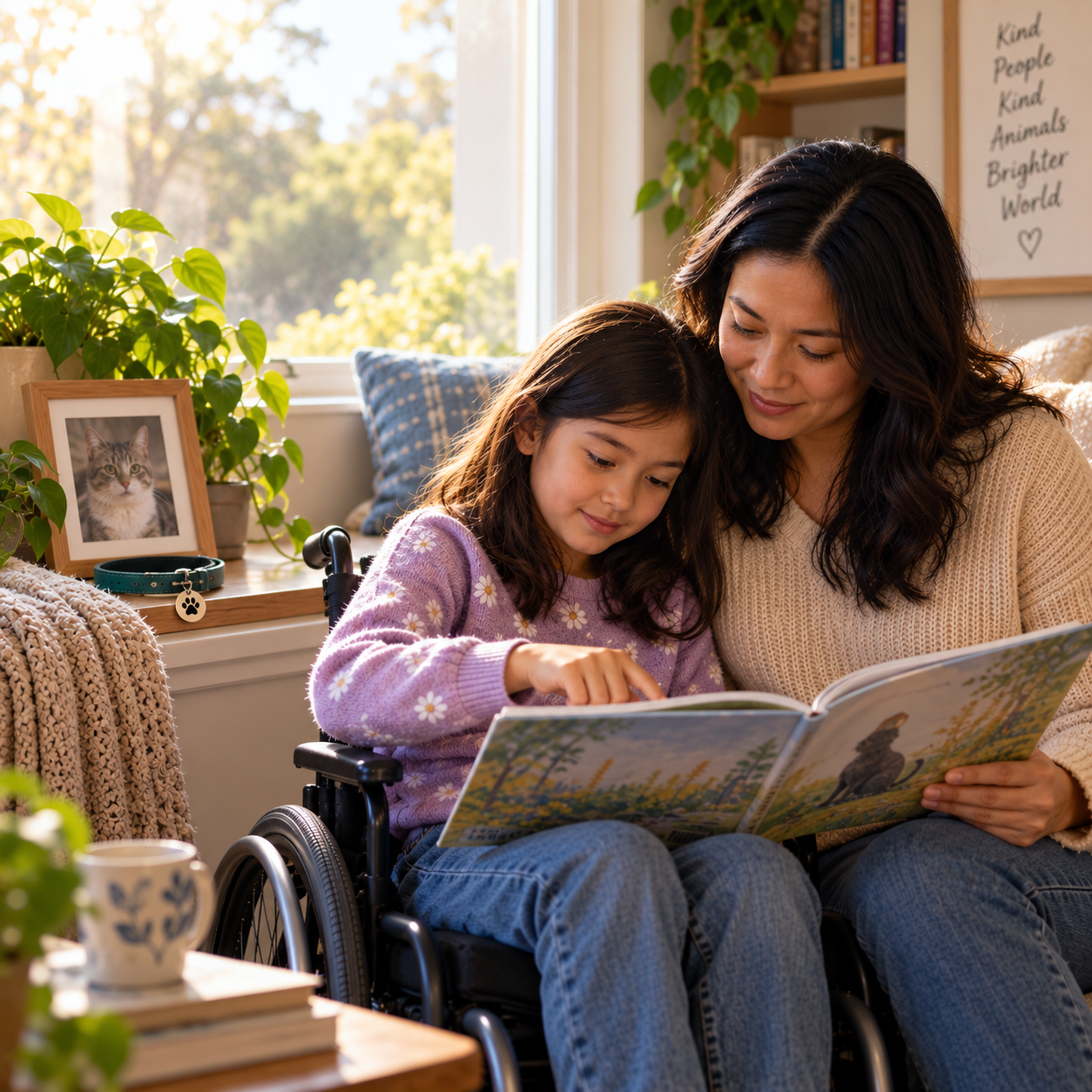
For many children, the death of an animal companion might be their first significant experience with death or loss. The dog who has slept at the foot of their bed for as long as they can remember is suddenly gone. The cat who appeared every morning at breakfast is no longer there. A guinea pig's cage is empty. The child comes home from school, and no one is waiting at the window.
Adults may be grieving the same animal while also trying to figure out how to help a child understand what’s happened. We want to use the right words. We want to answer questions without frightening them. We want to make room for sadness without making the loss even harder. Sometimes, though, we aren't quite sure how to begin the conversation.
A storybook can give us a place to start.
Books can't do the grieving for a child, and there isn't one perfect story that will make the loss understandable or take away the pain. What a story can do is create a shared space where a child and adult can encounter death, feelings, memories, and questions together. Sometimes it is easier to begin by talking about what happened to an animal in a story before talking about the animal whose absence is still so painfully present in your own home.
📖 Why Stories Can Help Us Talk About Death
Stories give children a little emotional distance from an experience that can feel enormous. Asking a child directly, How do you feel about Max dying? might be difficult to answer, particularly if the child doesn't yet have words for what they are experiencing. But while reading together, you might notice, The boy in this story seems really angry that his dog died. The child can talk about the character first. If they want to connect that feeling to their own experience, the door is open.
Books can also provide language for experiences children don't yet know how to name. A character might feel sad one moment and angry the next. Someone might worry that the animal's death was somehow their fault. A child in a story might want to talk constantly about the pet while someone else doesn't want to talk at all. Seeing those experiences represented can quietly communicate, Other people have feelings like this too.
That doesn't mean every page needs to become a therapeutic conversation. Sometimes the most helpful thing an adult can do is simply read the story, notice what catches the child's attention, answer questions as they arise, and allow silence when there isn't anything to say. The story creates an opening. The child doesn't have to walk through it immediately.
🌱 Children Understand Death Developmentally
Children's understanding of death changes as they grow. Very young children may not yet understand that death is permanent. A three- or four-year-old might ask when the dog is coming home even after being told several times that the dog died. Repeating the question doesn't necessarily mean the child wasn't listening. The child can be trying to understand an idea that is still developmentally difficult to grasp.
By the early elementary years, children increasingly understand that death is permanent and that living things die, but their thinking can still include elements of what developmental psychologists sometimes call magical thinking. A child might wonder whether being angry with the cat somehow caused the cat to die, or whether behaving better could make the animal come back. Children at this age might also ask remarkably concrete questions: What happens to the body? Does she feel anything? Where will she be buried?
Around ages ten to twelve, children generally have a much more complete understanding of the biological reality and permanence of death. Their questions can become more complicated too. They might wonder whether an animal suffered, whether euthanasia was really necessary, whether the adults made the right decision, why death happens when it does, or what happens after someone dies. Their ability to understand death may be developing faster than their ability to manage all the emotions that accompany it.
Teenagers may understand death much as adults do, but that doesn't mean they grieve like adults, or that they want adults closely involved in every part of their grief. An animal who has been in the family for ten or fifteen years can represent childhood itself. That animal may have been a source of comfort through family changes, friendships, school difficulties, adolescence, or periods of loneliness. A teenager might be devastated while saying very little, may turn toward friends rather than parents, or may want considerable privacy around the loss.
These developmental patterns are guideposts, not rules. Two eight-year-olds can respond very differently to the same kind of loss and both responses can make developmental sense. A child's previous experiences with death, cognitive development, neurodiversity, culture, religious or spiritual background, family communication, reading and emotional maturity, relationship with the animal, and circumstances surrounding the death can all influence what the child understands and needs. Age gives us useful information, but parents and guardians know their child best. The individual child's understanding, questions, and needs should always guide the conversation.
💛 Children's Grief May Not Look Like Adult Grief
Adults sometimes expect grief to look like sustained sadness. Children often move into and out of grief much more visibly. A child might cry intensely because the dog died and ten minutes later ask whether they can go outside and play. They haven't forgotten the dog, and the grief wasn't insincere. Play may simply be where the child needs to be for a while.
Grief can also appear in ways adults don't immediately recognize. Children can become clingier or more irritable, have trouble sleeping, return temporarily to behaviors they had previously outgrown, complain of stomachaches or headaches, repeatedly tell the story of what happened, or reenact aspects of illness or death in their play. Some children ask the same questions again and again. Others seem remarkably unaffected, at least from the outside.
A story can help normalize that range without prescribing a correct response. If one character cries and another gets angry, a child can see that grief contains more than one emotion. If a character wants to remember the animal while someone else needs a break from talking about it, the story can make room for both. We aren't trying to teach children the right way to grieve. We're helping them learn that grief can take many forms and that their experience has somewhere to belong.
🗣️ Gentle Doesn't Have to Mean Vague
Adults often reach for euphemisms because we want to protect children. We might say that an animal was “lost,” “went away,” “went to sleep,” or was “put to sleep.” An adult understands the intended meaning, but a young child can hear those words quite literally. If dying means going to sleep, sleep itself can become frightening. If the dog was “lost,” why isn't everyone looking for her? If the cat “went away,” perhaps he could decide to come back.
Clear language can actually be gentler because it gives a child something understandable to work with. Depending on the child's age and the circumstances, an explanation might be as simple as: Bella died. Her body stopped working, so she doesn't breathe, eat, play, or feel pain anymore.
This is something to notice when choosing storybooks too. Before reading a book with a child, look at the language it uses to describe death. A beautifully illustrated book may still rely on metaphors that aren't a good fit for a child who is trying to understand what literally happened. For another, older child, metaphor may provide exactly the kind of symbolic language they need. The question isn't whether one approach is universally better. It's whether the book fits the child who will be hearing the story.
🌈 What Does the Story Say Happens Next?
Pet-loss books also differ considerably in what they say—or imply—about what happens after an animal dies. Some remain spiritually neutral and focus on memory and relationship. Others talk about heaven, the Rainbow Bridge, spirits, or animals continuing to be present in some way. Still others are grounded in specific cultural or religious traditions for remembering and maintaining connection with the dead.
Those differences don't automatically make one book better than another. They do mean adults should know what a book contains before sharing it with a child. A story about a dog joyfully living in heaven can be deeply comforting in a family where that belief is part of their faith. The same story might be confusing in a family with different beliefs about death or an afterlife.
Sometimes a book can even provide a way to talk about uncertainty. An adult might say, This story says the dog went to heaven. Some people believe that's what happens when animals die. What do you think? You don't need to have every spiritual question resolved before talking with a child. It’s okay to distinguish between what we know about the animal's body, what our traditions teach, what we personally believe, and what we simply don't know.
🐕 Another Animal Doesn't Replace This One
When a child is hurting, adults naturally want to make the hurt smaller. That can lead to a well-intended promise: Maybe we'll get another puppy.
There might indeed be another puppy someday. Loving another animal doesn't diminish the relationship with the one who died, and welcoming a new companion can eventually become another meaningful chapter in a family's life. But a new animal cannot replace this particular relationship. The child who says, I don't want another dog. I want my dog, is telling us something important.
Rather than moving quickly toward new pet, we can help children remain with the relationship that mattered. What did they love about this animal? What made them laugh? What did the animal always do when they came home? What will they miss? What do they never want to forget? Storybooks can help because they often give children permission to remember the ordinary details of life with an animal rather than focusing only on the moment of death.
Grief isn’t evidence that a child needs a substitute relationship. It’s evidence that this relationship mattered.
🪞 Children Are Watching How We Grieve, Too
When a family animal dies, adults aren't only explaining grief to children. We’re also showing them what people do when someone they love dies.
If every tear is hidden, every reminder of the animal disappears immediately, or adults insist that everyone needs to “be strong,” children can begin to understand grief as something that should be concealed or quickly overcome. On the other hand, healthy modeling doesn't require adults to perform sadness, cry in front of children when that isn't natural for them or share emotions so intensely that the child feels responsible for taking care of the adult.
What we can model is that grief is safe and allowed. A parent might cry and say, I'm crying because I miss Charlie. I loved him very much, and it's okay to feel sad when someone we love dies. Later, that same parent and child might laugh while remembering the time Charlie stole an entire sandwich from the kitchen counter. Neither moment cancels the other.
We can model curiosity about the child's grief too. Instead of saying, This is the sad part. Does this make you sad? we might say, The girl in this story seems angry that her dog died. Have you ever felt angry about what happened to Charlie? The difference is subtle but important. One tells the child what the emotional response should be. The other makes room for the child to tell us what the experience actually is.
📚 Let Children Have Some Say in the Story
Loss takes away control. Children don't get to decide that an animal won't become ill, won't grow old, or won't die. Depending on the circumstances, they may have had very little say in veterinary decisions or what happened to the animal's body afterward. Small opportunities for choice can therefore matter.
An adult might preview several appropriate books and let the child decide which one to read. One child might choose the funny story. Another wants the book with a dog who looks like theirs. One wants to know exactly what happens when an animal dies, while another is drawn to a story about heaven. An older child or teenager might reject every book we offer, and that choice deserves respect too.
The goal isn't to get the child to complete a grief activity. We're offering resources and remaining available. Sometimes a book will be read immediately. Sometimes it will sit untouched beside the bed for two weeks before the child picks it up alone.
🕯️ When a Story Leads to Remembering
Reading can also lead naturally into ritual and remembrance. A child might want to draw the animal, write a letter, choose photographs for a memory box, plant something outside, make a small memorial, tell favorite stories at dinner, or keep the animal's collar somewhere special. Another child might not want to do any of those things.
There’s no need to turn the book into an assignment. Instead, we can notice the openings a story creates. If the family in a book holds a funeral, a child might ask whether their animal can have one. If a character makes a memory box, the child may want to make one too. If a story simply remembers all the ridiculous things a beloved pet used to do, perhaps the family spends an evening doing exactly that.
These small acts don't make grief disappear. They acknowledge the animal lived, the relationship existed, and what happened matters.
📚 Finding a Story That Fits Your Child
Because children, losses, families, and beliefs vary so much, there isn't one pet-loss book I’d recommend for every child. A story that’s wonderfully helpful for one family might be entirely wrong for another. That's why it can help to preview a book before sharing it, especially when the story involves euthanasia, burial, direct depictions of death, potentially frightening imagery, or particular religious or afterlife beliefs.
To make that process a little easier, I've created a companion Storybooks for Children After Pet Loss guide. The books are organized by developmental age, with several carefully selected places to begin in each group. Each recommendation includes a description of the book, why it might be helpful, and a Before You Choose This Book section highlighting things caregivers might want to know ahead of time.
The guide is intentionally a starting place rather than an exhaustive bibliography. School librarians and children's or teen librarians at public libraries can be wonderful resources for finding additional books, including newer titles and stories that better reflect a particular child's interests, culture, family, reading level, or experience. Knowledgeable staff in the children's and young adult sections of local bookstores can also have good suggestions. Tell them what you're looking for, and what you'd prefer to avoid. The best book isn't necessarily the one that appears on every pet-loss reading list. It's the one that offers this child and this family a useful place to begin.
💛 You Don't Need the Perfect Words
When an animal dies, adults can put tremendous pressure on themselves to handle the conversation correctly. We want to protect children while also telling them the truth. We want to answer their questions without giving them more than they're ready to understand. And when we're grieving too, finding exactly the right words can feel nearly impossible.
Fortunately, children don't need us to have a perfect script. They need adults who are willing to answer the same question again when it returns, listen when they want to talk, respect when they don't, make room for anger as well as tears, remember the animal with them, and admit when there are questions we simply cannot answer.
A storybook can help us begin that conversation, but the most important part isn't necessarily what's printed on the page. It's what happens around the book: the child leaning against us while we read, the question that comes three pages later, the memory that suddenly makes everyone laugh, the silence we don't rush to fill, or the story about the animal that gets told one more time.
At Life & Death Services, support for families facing an animal's aging, serious illness, or death includes making room for the human side of these experiences too. When children are part of the family, that can mean thinking together about age-appropriate conversations, anticipatory grief, saying goodbye, remembrance, and rituals that allow everyone to participate in ways that feel right for them.
We can't make the death of a beloved animal stop hurting simply by finding the right book. But we can give children language, stories, choices, and space for what they're experiencing.
And sometimes, sitting together with a story is a very good place to start.
📚 Looking for a book to help start the conversation?
I’ve put together a companion guide with storybooks and grief resources for children and teens, organized by age. Each recommendation includes what the book explores, why it may be helpful, and things parents and guardians may want to know before choosing it.
Download the free guide: Helping Children After the Death of a Pet